
A blocked Israeli bank account can turn an ordinary payment issue into a multi-jurisdiction commercial crisis under tightening 2026 compliance expectations. The wrong response usually starts with the wrong lawyer.
Foreign companies often assume that a crowded legal market makes selection easy. In Israel, the opposite is usually true. Counsel choice affects not only the legal file, but also banking access, business continuity, counterpart pressure, and cross-border coordination.
Why Finding the Right Israeli Lawyer Is a Strategic Challenge
Israel offers abundance, but abundance creates noise. By 2024, the total number of registered lawyers with licenses in Israel reached nearly 90,000, up from 40,469 active lawyers in 2009, according to Legal Business on the Israeli legal market.

That volume doesn’t simplify the search for lawyers in Israel. It makes specialization harder to verify, especially for non-Israeli companies that need commercial judgment under pressure rather than generic legal service.
Why volume creates risk
A multinational client rarely needs a lawyer who can merely file documents. It needs counsel who can evaluate strategic positions, sequence communications, protect management, and decide when escalation helps or harms.
In practice, three mistakes appear often:
- Mistaking availability for suitability. A lawyer who answers quickly isn’t necessarily equipped for a banking, shareholder, or enforcement crisis.
- Relying on name recognition alone. A known office may still assign the matter to a junior team without crisis authority.
- Treating Israeli counsel as local-only support. That model fails when the dispute touches foreign banks, overseas counterparties, or multilingual evidence.
Practical rule: In Israel, counsel selection is a business continuity decision first and a procurement exercise second.
What sophisticated clients actually need
The sound approach starts with a narrower question. Which lawyer can control the situation, preserve optionality, and coordinate legal pressure without losing time to internal confusion?
That question matters because Israeli commercial disputes often move on speed, documentation quality, and tactical communication. A lawyer who understands those realities will protect more than the case. That lawyer will protect the client’s operating position.
Where to Search for High-Caliber Legal Counsel
The search for lawyers in Israel should start with verification, not marketing. Israel has the highest density of lawyers per capita globally, with one lawyer for every 128 residents as of 2024, as noted in the Robus annual report on the legal sector in Israel.
That level of saturation means a foreign company needs a disciplined longlist process. Informal referrals can help, but they shouldn’t control the decision.
Start with official validation
The first screen should confirm licensing status and basic professional legitimacy through the Israel Bar framework. That doesn’t prove commercial strength, but it removes obvious errors early.
After that, the useful question isn’t whether a lawyer exists. The useful question is whether the lawyer regularly handles the type of matter at issue.
A stronger longlist usually combines these channels:
- Bar registration checks. Use them to verify standing and identity.
- Recognized international directories. They can help identify firms with visible commercial and cross-border activity.
- Cross-border legal networks. These matter when the Israeli file must align with action abroad.
- Transaction counterpart recommendations. These can be useful, but only after independent review.
What each channel can and can’t tell you
International directories often identify firms that understand foreign client expectations, reporting discipline, and complex transactions. Still, a directory listing doesn’t reveal who will run the crisis.
Networks matter for a different reason. If the problem requires action in more than one country, network access can reduce friction and improve consistency across jurisdictions.
A good referral opens a door. It doesn’t complete due diligence.
Build a longlist around the matter type
Search by problem, not by broad practice label. A company dealing with founder fallout, a frozen payment flow, or a distressed distributor shouldn’t begin with a generic “commercial lawyer” search.
Instead, structure the longlist by the dispute’s operational center:
- Banking and payment disruption for account restrictions, returned checks, and urgent correspondence with financial institutions.
- Corporate control conflict for shareholder deadlock, management authority, or partnership breakdown.
- Contract failure for franchise, supply, licensing, distribution, or service disputes.
- Litigation pressure for injunctions, urgent applications, or aggressive pre-action positioning.
That approach produces fewer names, but better names. In the Israeli market, fewer is often better.
Vetting Specialist Counsel for Commercial and Crisis Matters
The decisive issue isn’t whether a firm sounds impressive. The decisive issue is whether the specific lawyer can carry a high-stakes file without losing pace, authority, or commercial perspective.

As of 2025, 95.21% of tracked legal entities in Israel are single-owner operations, which means clients must verify the actual practitioner’s resources and active caseload, as discussed in this analysis of regulation and legal services in Israel. For foreign companies, that point is critical. A respectable brand can still mask very limited execution capacity.
Questions that expose real capability
A proper vetting meeting should test judgment under pressure. Broad biographies and polished websites won’t do that.
Ask questions that force operational answers:
- Who leads the matter day to day. Ask for names, roles, and decision authority.
- How does the lawyer handle urgent escalation. The answer should include sequence, counterpart communication, and evidence control.
- What happens if the matter expands. Capacity planning matters when a banking issue becomes litigation or media-sensitive conflict.
- How does counsel report to foreign management. Clarity on cadence, document flow, and executive summaries matters more than style.
A strong lawyer can explain process without breaching confidentiality. A weak one usually stays abstract.
Capacity matters more than branding
Many clients overvalue reputation and undervalue throughput. In crisis matters, responsiveness without depth is dangerous, but prestige without availability is just as risky.
Look for signs of real capacity:
| Indicator | What it suggests |
|---|---|
| Clear lead partner involvement | Better strategic consistency |
| Defined support team | Better document control and speed |
| Experience with foreign stakeholders | Fewer translation and expectation gaps |
| Structured escalation logic | Better crisis containment |
If counsel can’t describe the first three moves after a bank restriction or demand letter, the client is still buying uncertainty.
For executives who manage legal exposure across markets, outside resources on legal crisis management for UK SMEs can also sharpen internal preparedness. The underlying lesson applies in Israel as well. Crisis planning starts before the formal dispute.
Red flags that deserve immediate attention
Some warning signs appear early and shouldn’t be ignored.
- Vague ownership of the file. If nobody clearly owns the matter, delays will follow.
- No discussion of commercial objectives. A lawyer who talks only about procedure may miss the business risk.
- No cross-border instinct. If foreign counsel coordination feels like an afterthought, the file may fracture.
- Overconfidence without framework. Crisis work needs method, not performance.
The best lawyers in Israel for commercial crises don’t just know the law. They know how to convert pressure into advantage without wasting motion.
Strategic Analysis Israeli Bank Account Restrictions
What happens when a routine payment failure triggers a banking restriction just as your Israeli operation needs to pay staff, suppliers, or a foreign counterparty? Under stricter compliance culture heading into 2026, that problem can escalate fast.
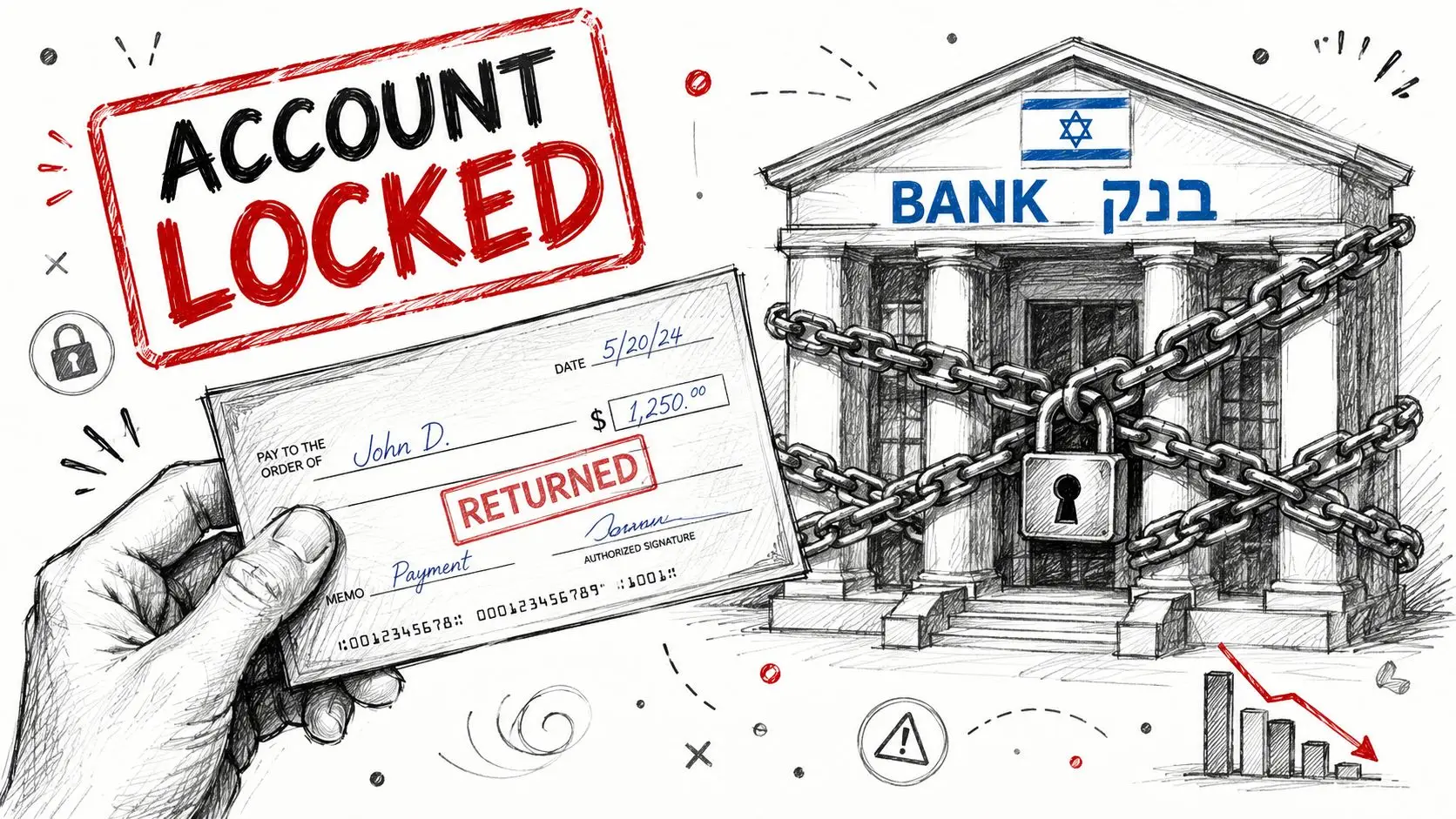
Generic guidance about lawyers in Israel usually fails because it treats bank restrictions as a narrow banking issue, when they often operate as a full commercial crisis involving reputation, supplier confidence, internal governance, and urgent legal correspondence.
Why this problem demands specialist judgment
A restricted account affects more than incoming and outgoing payments. It can also change how counterparties negotiate, how banks classify risk, and how management documents decisions.
The legal issue and the operational issue move together. Counsel must therefore do more than review the file. Counsel must stabilize the business environment around the file.
For a practical legal overview of these disputes, the relevant starting point is bank account blockages in Israel. The broader strategic framework appears in commercial crisis management.
A bank restriction is rarely just a banking event. It is often the moment when every unresolved weakness in the business becomes visible at once.
What works and what fails
The ineffective response is reactive and fragmented. Management speaks to the bank, finance speaks to suppliers, and outside counsel receives partial information after key deadlines have passed.
The effective response is centralized and staged. One legal strategy governs communications, evidence preservation, internal instruction, and any required escalation.
A disciplined response usually includes:
- Immediate document capture. Gather notices, returned check records, internal approvals, and relevant account history.
- Single channel communication. Route external statements through one legal and executive line.
- Commercial mapping. Identify which obligations are urgent and which can be deferred or renegotiated.
- Counterparty containment. Address major suppliers, landlords, and strategic partners before rumor fills the gap.
The phased legal path
A serious practitioner approaches these files in phases, not in panic.
Phase one focuses on diagnosis. Why did the restriction arise, what documents control the issue, and which immediate business functions face danger?
Phase two focuses on pressure design. That can include formal correspondence, banking submissions, internal remediation, and preparation for urgent proceedings if needed.
Phase three focuses on recurrence prevention. A business that solves the immediate blockage but leaves governance and payment controls unchanged remains exposed.
This kind of staged legal work requires the same strategic discipline that stronger firms now apply to visibility in modern legal markets. Even a non-legal resource such as AI search strategies for law firms illustrates a useful point. Structured systems outperform ad hoc reactions.
Risk mitigation steps for foreign companies
A non-Israeli company with an Israeli entity, distributor, or operating account should adopt an objective protocol before any crisis emerges.
-
Assign authority in writing
Determine who can instruct Israeli counsel, speak to the bank, and approve urgent commercial concessions. -
Prepare bilingual evidence workflows
Keep account notices, board approvals, and contractual payment obligations organized in English and Hebrew where possible. -
Stress-test payment dependencies
Identify which payroll, lease, tax, or supply obligations would become critical if the account were restricted. -
Require a legal escalation matrix
Counsel should define informal contact, formal warning, banking challenge, and litigation thresholds in advance. -
Review founder and management conduct
Many banking crises reveal governance gaps. Those gaps need correction, not concealment.
A strong lawyer treats bank restrictions as a case study in commercial control. That’s why this issue often exposes the difference between ordinary local representation and strategic crisis counsel.
Decoding Fee Structures and Retention Agreements
Discerning clients don’t ask only, “What does this cost?” They ask, “Which billing structure aligns incentives, controls drift, and supports the objective?”
Israeli commercial work usually appears under four fee models. Each can work well if the engagement matches the task.
Comparison of Israeli Legal Fee Models
| Fee Model | Best For | Client Risk Profile | Key Consideration |
|---|---|---|---|
| Hourly | Unpredictable disputes and fast-moving crisis work | Variable | Scope can expand quickly if reporting and staffing aren’t controlled |
| Fixed fee | Defined projects, specific contracts, or limited legal correspondence | Lower on scope drift, higher on scope boundary disputes | The work description must be precise |
| Blended | Matters with a stable base and an uncertain escalation path | Moderate | Good for balancing predictability and flexibility |
| Contingency or success-based element | Select recovery or enforcement matters | Outcome-sensitive | Terms must define success, expenses, and settlement authority clearly |
How foreign clients should choose
Hourly billing suits crisis matters because facts change quickly. Still, the client should insist on staffing limits, update frequency, and decision points before major workstreams expand.
Fixed fees work well for contained assignments such as contract review, demand letters, or a defined banking submission. Problems arise when the engagement letter uses broad language and the parties assume different scope.
Client-side discipline: The fee model matters less than the precision of the instructions, the reporting method, and the authority matrix.
Clauses that deserve close review
A retention agreement should answer operational questions before the file turns difficult.
Focus on these clauses:
- Scope of work. It should define what is included and what triggers a new phase.
- Who handles the matter. The named team should match the people presented during discussions.
- Billing mechanics. The agreement should explain timing, disbursements, and approval thresholds for substantial extra work.
- Communication protocol. Cross-border clients need decision makers, reporting cadence, and document routing identified early.
- Termination terms. Exit rights should be clear if strategy, staffing, or budget discipline breaks down.
The best engagement letters don’t merely authorize legal work. They create a management structure around it.
Ensuring Seamless Cross-Border Legal Coordination
A foreign company doesn’t need an Israeli lawyer who works in isolation. It needs one who can run the Israeli piece without losing alignment with the wider dispute, transaction, or restructuring strategy.
That demand becomes sharper when the matter touches foreign banks, offshore shareholders, or multinational counterparties. Legal correctness inside Israel won’t solve the problem if the messaging, timing, or evidence trail collapses outside Israel.
What coordinated counsel actually does
Cross-border coordination is practical, not theoretical. It means Israeli counsel can translate local developments into usable instructions for boards, general counsel, finance teams, and overseas firms.
It also means the lawyer can maintain one strategic line across jurisdictions. Without that, companies often produce conflicting positions, duplicate work, or inconsistent settlement signals.
Three capabilities matter most:
- Reporting discipline so overseas decision makers receive concise updates they can act on.
- Document control so contracts, translations, and correspondence remain consistent across countries.
- Jurisdictional sequencing so action in Israel supports, rather than undermines, action elsewhere.
Why this matters in ordinary commercial work too
The issue isn’t limited to headline disputes. Even operational files can become cross-border quickly, especially where leases, distributors, franchise structures, or management agreements involve foreign ownership or guarantees.
That is why matters involving commercial lease agreements in Israel often require more than local drafting skill. They require coordination across ownership structures, finance approvals, and enforcement expectations in more than one jurisdiction.
A firm with reliable international coordination can usually protect momentum. A firm without it may still produce good local work, but the client then carries the burden of integration.
Cross-border legal work succeeds when one team owns the strategic map and every jurisdiction follows it.
For multinational clients, that’s not a premium feature. It’s part of basic risk control.
Conclusion Your Next Steps
Finding the right lawyers in Israel isn’t a directory exercise. It’s a strategic selection process shaped by market saturation, practitioner capacity, crisis-readiness, fee discipline, and cross-border execution.
The strongest path is usually straightforward. Verify the individual lawyer, not just the firm. Test crisis methodology before signing. Demand a clear engagement letter. Require reporting and coordination that match an international business, not a domestic file.
To avoid costly mistakes and secure a strategic advantage in your Israeli commercial matters, the recommended path is to engage expert counsel immediately. Contact our firm now to design a legal strategy that protects your interests.
This article provides general information only and doesn’t constitute legal advice. It doesn’t replace legal counsel suited for a specific matter, jurisdictional posture, banking issue, or dispute strategy, and any reliance on it is solely at the reader’s own risk.
Avoid costly mistakes by addressing Israeli commercial risk before it hardens into litigation, banking restrictions, or cross-border disruption. For strategic guidance on complex business disputes, crisis management, and international commercial matters, contact RNC Group.