
If your 2026 dispute budget still begins after the statement of claim, the budget isn’t a control tool. It’s a post-mortem. For non-Israeli companies dealing with litigation in or connected to Israel, that mistake often starts with a false assumption. Foreign management teams expect the legal merits to drive cost. In practice, process design, forum pressure, document volume, and timing usually decide whether a dispute stays commercially rational.
Cross-border disputes also punish delay more than domestic ones. Internal documents sit in different languages, witnesses work across time zones, and local procedure can alter the strategic advantage before a foreign board has even approved a strategy. That’s why effective litigation cost management starts before formal escalation, not after it.
Are Your Litigation Budgets Built on Hope or Data
Many companies still treat major litigation as unbudgetable. That view is comfortable, but it’s expensive. It also ignores a basic commercial reality. A legally valid claim can still be a poor business decision.
The cost burden can become material very quickly. A U.S. court survey found that major companies reported average annual outside litigation spend of nearly $115 million in 2008, up 73% from 2000, with litigation costs averaging about 0.6% of revenue and discovery accounting for at least one-fourth of outside legal fees, as discussed in this analysis of litigation cost control and early decision-making.
For a foreign company entering a dispute linked to Israel, the danger usually isn’t one dramatic invoice. It’s a series of untested assumptions. Management assumes the claim will settle early. Counsel assumes discovery will stay narrow. Finance assumes spend will track the first estimate. None of those assumptions deserves board approval without pressure testing.
The first question isn’t who is right
The first serious question is whether the case is economically rational. That requires an early view of likely spend, business disruption, management attention, interim advantage, and enforcement reality. If that analysis happens late, the company starts making legal moves that are hard to reverse.
Practical rule: No company should file, defend aggressively, or reject settlement without first comparing expected litigation spend against the realistic commercial value of the outcome.
That comparison has to be disciplined. A damages figure on paper isn’t the same as recoverable value. A strong legal defense isn’t the same as a cheap defense. A principled refusal to settle isn’t the same as a strategy.
Why budgets fail in cross-border matters
Traditional budgets fail because they usually describe activity, not decisions. They list pleadings, hearings, motions, and experts. They rarely identify the points where management can still stop, narrow, settle, or restructure the fight.
A better approach treats the budget as a decision architecture. Each phase must answer a business question. Should the company escalate? Should it preserve optionality? Should it settle before discovery expands? Should it separate one issue for faster resolution?
That level of discipline also depends on visibility into lawyer time and task patterns. Even basic systems for tracking billable hours can help legal and finance teams identify where work is spreading beyond the agreed scope.
Boards don’t need perfect forecasts. They need reliable control points. Hope isn’t a budgeting method. Data, assumptions, and explicit decision gates are.
The Proactive Budgeting Framework
A sound litigation budget begins with early case assessment. That means defining the merits, the commercial stakes, the procedural threats, and the specific drivers likely to consume time and money. Without that step, the budget is only a rough guess dressed up as planning.
A practical method is straightforward. First, assess the case early. Then build a phase-based budget around the primary cost drivers. Discovery often consumes 50-70% of total litigation expense, and a 10-20% contingency reserve is commonly used to absorb uncertainty, according to this practical guide to civil litigation cost management.
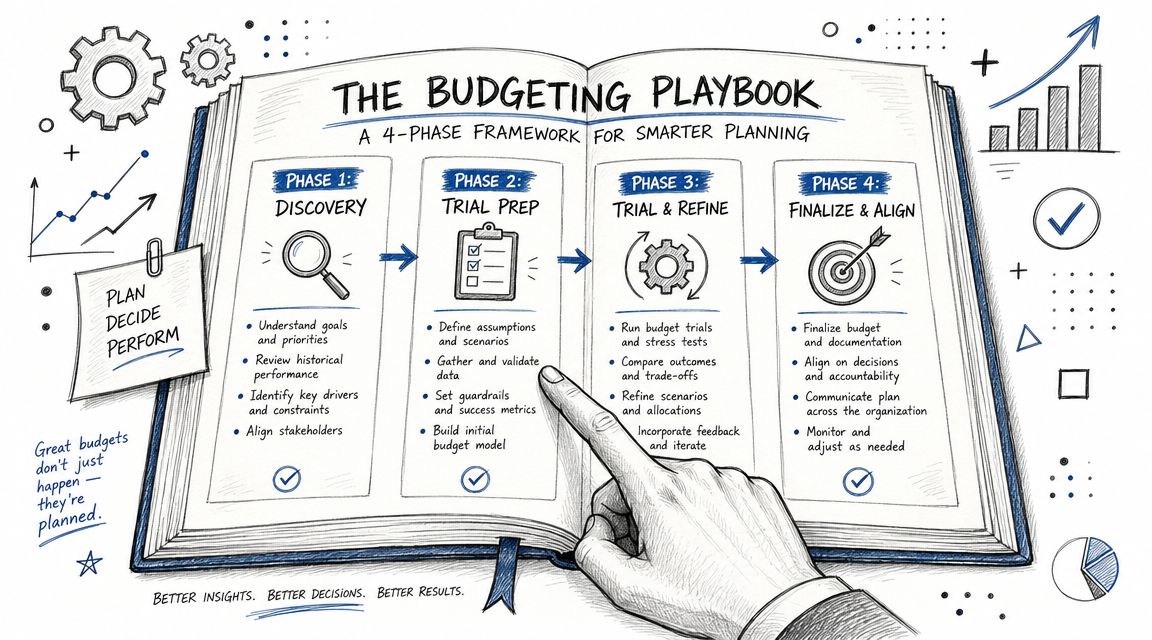
Build the budget by phase, not by optimism
The budget should divide the matter into phases with separate assumptions, outputs, and approval gates. That structure gives management room to act before costs harden.
A typical framework includes:
-
Initial assessment and position setting
Review contracts, correspondence, forum options, urgent remedies, and document sources. At this stage, the company should also identify who controls the facts inside the business. -
Pleadings and procedural shaping
Narrow the issues early. Jurisdiction challenges, pleading attacks, and targeted procedural applications can reduce later spend if counsel uses them with discipline. -
Discovery and evidence development
Budgets usually break at this stage. The document universe expands, privilege review grows, and witness preparation starts consuming management time. -
Expert, hearing, and resolution phase
Expert work, hearing bundles, cross-examination prep, and settlement positioning need separate controls. If these costs enter too early, the case often loses commercial balance.
Discovery needs hard limits
Discovery doesn’t become expensive by accident. It becomes expensive because teams allow scope creep under the label of thoroughness. In cross-border matters, that risk multiplies when data sits across multiple subsidiaries, custodians, and languages.
Use concrete controls:
- Define custodians early: Limit whose data enters the first review set.
- Set issue-based collection boundaries: Don’t collect everything because it exists.
- Agree review protocols: Use relevance rules, privilege rules, and duplicate handling before review starts.
- Tie depositions and experts to phase goals: If a witness or expert doesn’t advance a decision point, defer the cost.
Broad collection is easy to approve in the abstract. It becomes far harder to justify once management sees who must stop working to support it.
This is also where upstream contract discipline matters. Many disputes become more expensive because the contract file is fragmented, approval chains are unclear, and operative versions are disputed. Teams trying to prevent that problem before litigation can use tools that discover solutions for contract chaos and improve document control long before a claim appears.
A budget should trigger decisions
The budget isn’t finished when the spreadsheet is circulated. It works only if each phase ends with a board-level or executive-level question. Continue, settle, narrow, or escalate. That’s the discipline that keeps a high-stakes matter from becoming an unmanaged operational drag.
In a dispute arising from a complex commercial lease arrangement, for example, the initial phase might focus on document reconstruction, payment history, notice validity, and interim strategic advantage. Expert valuation and extended witness work shouldn’t begin merely because they may become useful later. They should begin only if the earlier phase justifies the spend.
Deciding Between Escalation and Settlement
Settlement decisions often go wrong for opposite reasons. Some companies settle weakly because outside pressure feels intolerable. Others escalate reflexively because the legal position looks strong on paper. Neither approach is disciplined enough for a serious commercial dispute.
The better method is to test escalation against a structured matrix. Legal merits matter, but they are only one variable. A company also needs to evaluate disruption, enforceability, management distraction, precedent risk, and whether the opponent can absorb pressure.
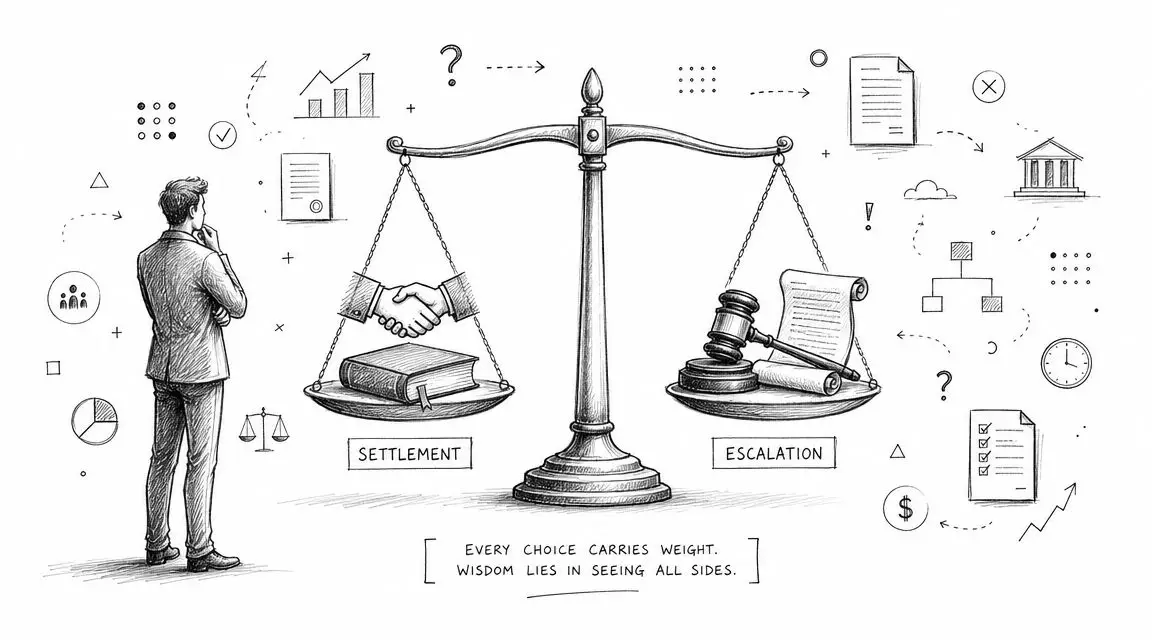
When a strong case is still the wrong case
A legally persuasive claim may still be commercially irrational if winning requires years of executive attention, wide disclosure, and expensive enforcement. That is especially true when the dispute touches a key distributor, local bank relationship, regulator-facing issue, or an operating subsidiary in Israel.
Conversely, some cases justify aggressive spend. If the dispute threatens control of a brand, a critical revenue channel, a strategic supplier relationship, or an important market narrative, settlement at the wrong moment can cost more than litigation.
A useful decision matrix looks like this:
| Decision factor | Settlement points toward action when | Escalation points toward action when |
|---|---|---|
| Recoverable value | The likely business outcome is modest or hard to enforce | The likely outcome protects or recovers a core business interest |
| Operational disruption | Management time and internal burden are already too high | The business can ring-fence key people and sustain the process |
| Opponent behavior | The opponent signals realistic commercial movement | The opponent only responds to credible procedural pressure |
| Reputational sensitivity | Public process increases downside | A clear and firm stance protects market position |
| Future relationships | Ongoing dealings still matter | The relationship is broken or no longer strategic |
The hidden variable is leverage timing
Many executives ask whether they should settle. The sharper question is when their advantage is strongest. Sometimes the right settlement window appears before wide disclosure. Sometimes it appears after one decisive procedural win. Sometimes it appears only after the opponent realizes the company will proceed.
A settlement reached from weakness usually buys quiet for a short time. A settlement reached after disciplined pressure can end the dispute on usable terms.
That’s why legal teams should map not only the cost of continuing, but also the likely strategic impact of each next move. A motion, injunction request, banking measure, preservation order, or commercial demand letter may alter the strategic advantage. It may also provoke cost and retaliation. Those trade-offs must be explicit before the move is made.
The same discipline applies in disputes that require coordinated crisis management for companies. Once legal pressure intersects with shareholders, media, banking, or supply chains, the wrong escalation step can increase cost while reducing strategic room.
Settlement is not capitulation. Escalation is not strength. The right choice depends on whether the next legal dollar buys a meaningful commercial advantage.
Leveraging Alternative Fee Arrangements
Hourly billing remains common because it is easy to describe. It is often much harder to manage. In complex disputes, pure hourly billing can blur the line between necessary work and expanding work. That isn’t always a problem of bad faith. It’s often a problem of weak alignment.
Alternative fee arrangements work best when the company knows what it wants from each phase. If the objective is predictability, one model fits. If the objective is sharing risk on outcome, another fits. If the objective is capping uncertainty in a narrow procedural stage, a third structure is better.
Matching the fee model to the phase
The company should negotiate fee terms by reference to task certainty. Early assessment, pleadings, and defined applications are usually easier to price than open-ended discovery or trial.
Here is a practical decision matrix.
| AFA Model | Description | Best Used When… | Key Benefit |
|---|---|---|---|
| Fixed fee by phase | A set fee covers a defined litigation stage | Scope is clear and outputs are identifiable | Predictability and easier approvals |
| Capped fee | Hourly billing continues, but with a hard ceiling | The phase may vary, but the company needs downside protection | Cost containment |
| Collared fee | The parties share overruns and underruns within agreed bands | Both sides want alignment without full fixed pricing | Shared efficiency incentives |
| Success-based component | Part of the fee depends on outcome or target result | The matter has clear commercial outcomes and measurable success points | Better alignment with business objectives |
| Blended structure | Different models apply to different phases | The case has both predictable and volatile stages | Flexibility without losing control |
What tends to work
Fixed fees often work well for early case assessment, initial pleadings, and specific applications. The scope is bounded. Deliverables are visible. The client can compare cost against a defined result.
Collared arrangements can work in discovery-heavy matters where exact volume remains uncertain. The firm has room to manage complexity, but it also carries some efficiency risk. That tends to produce better staffing discipline than open-ended hourly billing.
Success-based components can be useful, but only if success is defined with care. “Winning” is often too vague for a commercial dispute. A better trigger might be dismissal of a claim, preservation of an injunction position, achievement of a settlement threshold, or recovery against an enforcement target.
What usually fails
AFAs fail when the scope is vague. They also fail when the company negotiates price before it defines strategy. A cheap fixed fee for an undefined fight usually produces one of two outcomes. Either the firm narrows work defensively, or the matter returns to hourly billing through change requests.
Another common failure is trying to apply one model to the entire case from day one. Complex litigation rarely behaves that neatly. It is usually better to reprice at major gates than to force a single structure onto a moving target.
The best fee arrangement doesn’t eliminate cost. It makes cost visible, deliberate, and tied to a business objective.
For foreign companies in disputes connected to Israel, AFAs also help with internal governance. Boards and regional finance teams often need a budgeting logic they can compare across jurisdictions. A phase-based fee structure gives them that logic.
Managing Cross-Border Litigation Costs
Foreign companies often assume that the facts drive the budget. In cross-border litigation, jurisdiction can drive the budget just as forcefully. Procedure, disclosure norms, interim relief, language burdens, and enforcement pressure can alter the economics of the same dispute before the merits have been tested.
That isn’t a minor technical point. It is a central cost issue. A NERA study reported that U.S. liability costs were 2.6% of GDP, 2.6 times the Eurozone average, and four times higher than in Belgium, the Netherlands, and Portugal. It also found that legal-environment features explain more than 70% of the variation in adjusted liability costs across countries, as set out in this international comparison of liability-cost systems.

Forum analysis must happen early
When a dispute has links to Israel and another jurisdiction, management should test forum consequences immediately. That means more than asking where a case can be filed. It means asking where pressure can be applied efficiently, where evidence can be managed proportionately, and where interim steps may reshape the settlement advantage.
A board should ask:
- Which forum changes disclosure burden most materially
- Where can interim remedies alter strategic advantage early
- Which jurisdiction creates the least friction for witnesses and documents
- How difficult enforcement will be after judgment or award
- Whether parallel proceedings might duplicate cost
These questions are especially important for non-Israeli companies that rely on assumptions imported from home counsel. A team used to one procedural culture may badly underestimate how another system handles urgency, document scope, or enforcement sequencing.
Local pressure points change the economics
Cross-border disputes linked to Israel can involve commercial pressure points that foreign executives don’t anticipate early enough. Banking restrictions, document authentication issues, urgent injunction practice, and local procedural timing can all alter the settlement equation.
One example is the risk of bank account blockages in Israel. Even before a dispute reaches final determination, pressure around banking access can change operational capabilities, vendor confidence, and management priorities. If foreign decision-makers miss that possibility, they may budget for a legal dispute yet find themselves confronting a business continuity problem.
The cheapest mistake is the one avoided before filing
Cross-border cost control depends on coordination. Internal custodians need instructions quickly. Finance needs visibility into reserve assumptions. Local and foreign counsel need one decision chain. Translation, privilege, and communications planning need to begin before they become emergency work.
A disciplined cross-border protocol usually includes:
- One reporting line so foreign management doesn’t receive fragmented legal advice.
- One document map identifying where data sits, in what language, and who controls it.
- One strategic advantage assessment covering forum, interim remedies, and enforcement.
- One business continuity review so legal strategy doesn’t damage operations.
The most expensive cross-border disputes are often not the legally hardest ones. They are the ones run by disconnected teams across multiple jurisdictions, each reacting to local pressure without a common commercial plan.
Monitoring Performance and Proving Value
Litigation cost management fails when the company treats the budget as a document instead of a live control system. Once the matter begins, management needs a review rhythm, agreed metrics, and authority to intervene. Otherwise, the budget records drift.
A more disciplined framework uses historical data, matter-specific inputs, and a narrow category for true uncertainty. One legal budgeting model recommends sourcing 60% of the forecast from historical data, 30% from case-specific factors, and 10% from unknowns, while tracking budget accuracy rate and aiming to complete 80% of matters within 10% of the original budget, as described in this framework for trustworthy litigation budgeting.
What management should measure
Not every metric helps. The useful ones tell management whether the case is staying within the commercial logic approved at the outset.
A practical dashboard should include:
- Budget versus actual by phase: This exposes where the case is drifting.
- Variance cause: Separate scope expansion from poor forecasting.
- Decision-gate outcomes: Record what management approved, deferred, or rejected.
- Spend against objective: Track whether each major cost produced advantage, evidence, or resolution progress.
- Cycle time by major activity: Delays create cost even when invoices appear stable.
Who should sit in the review room
Outside counsel should not review the budget alone. The right group usually includes legal, finance, and the internal business owner closest to the dispute. In larger matters, companies may also ask specialist finance support to test assumptions, reserve logic, and accrual treatment. In some organizations, external finance support or Hire CPAs can help strengthen that cost-review discipline.
If no one can explain why a phase went over budget in plain commercial terms, the matter isn’t under control.
Review meetings should end with decisions, not summaries. Narrow discovery. Hold expert work. Expand pressure. Revisit settlement authority. Adjust reserves. Replace assumptions that have already failed.
The result is simple. Litigation becomes a managed business risk instead of a recurring surprise.
Avoid costly mistakes by getting a cross-border dispute strategy right at the outset. For companies facing litigation in or connected to Israel, the recommended next step is a structured assessment of forum, strategic options, cost drivers, and business exposure with RNC Group. To discuss the matter directly, use the firm’s contact page.
This article provides general information only and does not constitute legal advice. It does not create an attorney-client relationship, and readers should obtain legal advice suited to their specific facts, jurisdiction, and commercial objectives before taking or refraining from any action.