
A shareholder dispute rarely starts when a claim is filed. It starts much earlier, when founders sign an agreement that looks orderly on closing day but collapses under pressure in a board fight, a capital call, or a buyout. The critical question for 2026 is simple. Does the agreement direct conflict, or does it weaponize it?
That question matters because shareholder dispute resolution now sits in the center of cross-border commercial risk. According to 2025 HKIAC statistics, corporate and shareholder disputes constitute 23.6% of all arbitration cases, the largest single category, and the total value of pending cases across major forums reached US$299 billion. For non-Israeli businesses operating through Israeli companies, joint ventures, or holding structures, that reality changes the legal task. The focus isn’t on choosing a forum after the relationship collapses. Rather, the essential work involves building a strategic advantage, evidence, and procedural control before formal resolution begins.
Introduction Is Your Agreement a Roadmap or a Minefield
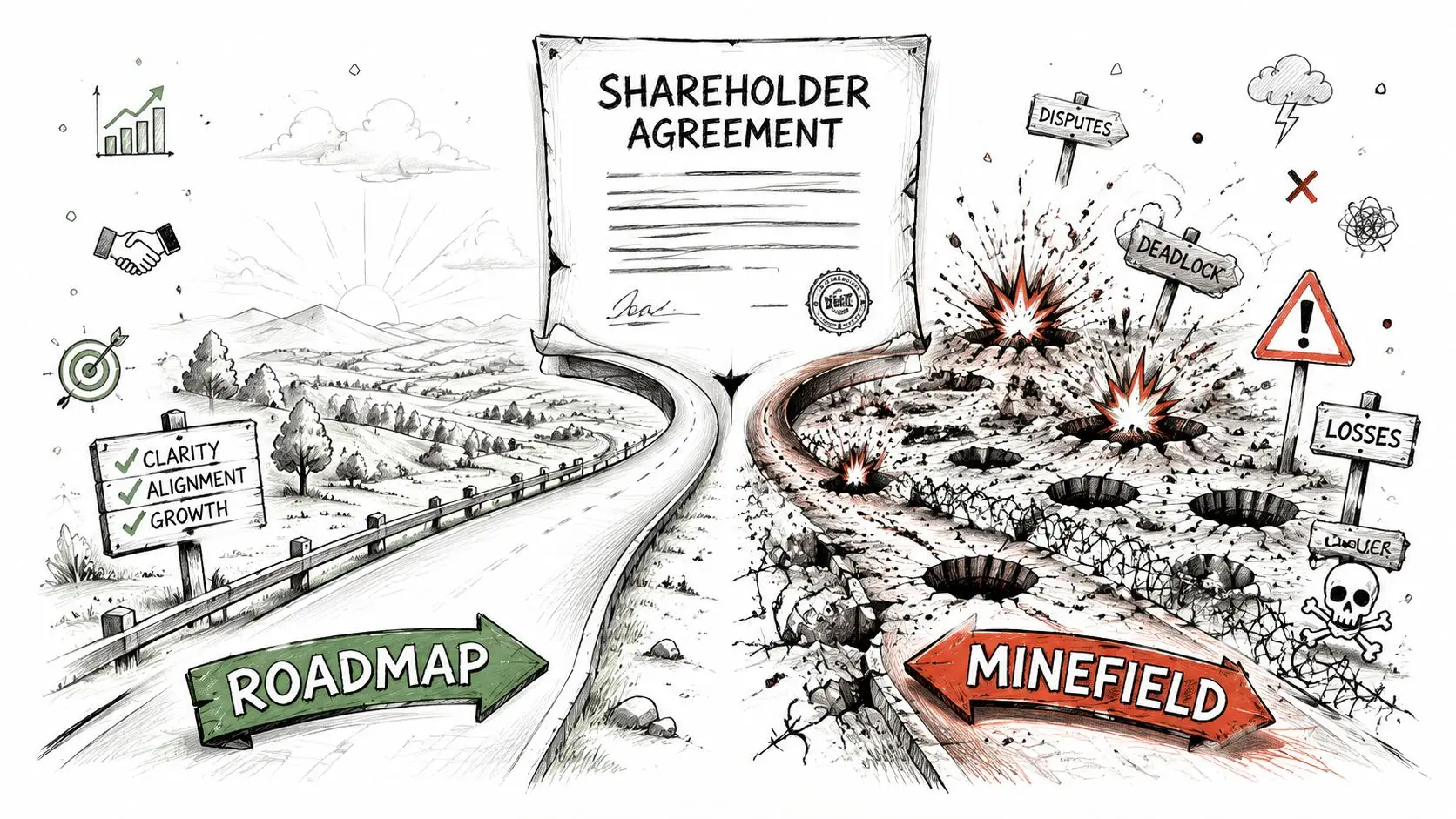
Most executives still treat the shareholder agreement as a static corporate file. That is a mistake. In practice, the agreement becomes an operational weapon the moment strategy diverges, liquidity tightens, or trust breaks down.
A strong agreement channels conflict into controlled stages. A weak one creates ambiguity over voting rights, funding duties, exit mechanics, valuation standards, board authority, and emergency remedies. Therefore, the first strategic review in any serious shareholder dispute resolution exercise isn’t emotional. It’s documentary.
Why the dispute is usually decided before proceedings start
By the time parties discuss arbitration, mediation, or court relief, they have already made several decisions that shape the outcome. They may have failed to preserve communications, ignored governance formalities, tolerated informal side deals, or let a technical valuation issue become a personal war. Those early choices often matter more than the venue itself.
Practical rule: The side that frames the facts first usually controls the settlement range later.
That is why effective dispute strategy starts with an internal audit of control points. The audit should identify who controls signatures, who controls cash flow, who controls board process, and who can trigger corporate action without consent. For businesses with Israeli exposure, that review should also account for local statutory remedies and procedural thresholds before any demand letter leaves the building.
Reputation pressure often arrives before legal pressure
Internal shareholder conflict also escapes the boardroom faster than parties expect. Lenders, counterparties, employees, and regulators often react to governance instability before a tribunal does. That is why a dispute plan should sit beside a communications and escalation plan, especially where allegations involve misconduct, deadlock, or misuse of company assets. A useful related reference on this broader risk lens is RNC Group’s crisis management analysis.
Three early questions usually separate manageable disputes from destructive ones:
- Control: Who can act today under the articles, bylaws, shareholder agreement, and banking mandates?
- Evidence: What documents already prove the commercial history, and what remains undocumented?
- Pressure points: Which issue moves the other side, valuation, governance access, dividend policy, liquidity, or reputation?
A business that answers those questions early doesn’t eliminate conflict. It prevents chaos.
Mapping Common Shareholder Conflicts
Not every shareholder dispute looks the same, and poor classification leads to poor strategy. A deadlock case requires a different response from an oppression case. A valuation fight doesn’t move like a fiduciary misconduct claim.
Deadlock and strategic paralysis
Deadlock usually appears when shareholders share formal power but no longer share direction. One side wants reinvestment. The other wants distributions. One side pushes expansion into a new market. The other blocks risk. The company then slows, not because the market failed, but because governance failed.
In closely held companies, deadlock often hardens around practical decisions. Bank signatories stop cooperating, budgets remain unsigned, and management appointments become political contests. At that point, the question isn’t who’s right in principle. The question is which mechanism can force movement.
Minority oppression and exclusion
A different pattern appears when the majority doesn’t merely disagree with the minority but marginalizes it. That can include withholding information, diverting business opportunities, manipulating salary or dividend policy, diluting influence, or using procedure to exhaust a smaller shareholder.
Under Israeli law, the oppression petition under Section 191 of the Israeli Companies Law 1999 is the primary statutory remedy for minority shareholders facing unfair treatment, allowing courts to grant a wide range of remedies from financial compensation to injunctive relief, as discussed in this overview of shareholder and partnership disputes in Israel. That matters because minority shareholders often assume they have no real tool unless they control votes. In fact, Israeli law can give them a direct path to relief.
Minority shareholders lose leverage when they argue fairness in general terms. They gain leverage when they prove a pattern of conduct against documented expectations.
Valuation fights and exit disputes
Many commercial wars become valuation wars. The parties may agree that someone must exit, but they can’t agree on price, methodology, discounts, treatment of debt, or treatment of future contracts. This happens often after trigger events such as breach allegations, death, disability, non-compete issues, or management failure.
These disputes become expensive when the agreement uses vague language like “fair value” without a mechanism. They become even worse when the company operates across jurisdictions and the books don’t align with the business narrative each side presents.
Common conflict categories include:
- Board control disputes: One faction claims management authority. The other challenges the validity of appointments or resolutions.
- Funding disputes: A shareholder refuses further capital, then objects when dilution or default consequences follow.
- Information access disputes: Minority investors seek records, while management restricts access by claiming confidentiality or privilege.
- Related-party conduct: One side alleges that insiders shifted contracts, clients, or assets outside the company.
The legal label matters, but the commercial pattern matters more. Once the pattern is identified, the resolution path becomes clearer.
The Escalation Ladder of Resolution Mechanisms
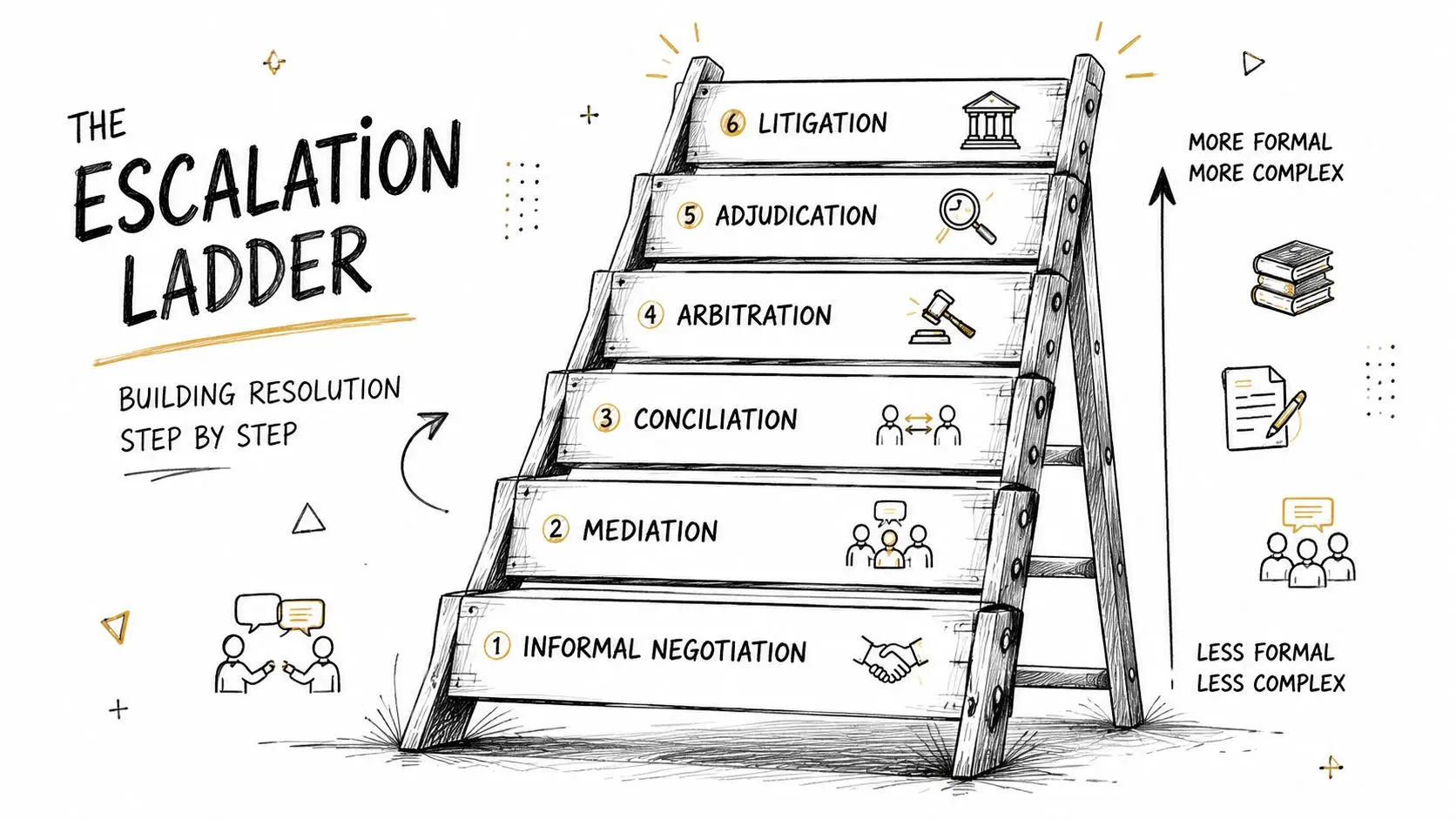
A disciplined dispute team doesn’t jump to the highest forum first. It builds an escalation ladder. That ladder preserves optionality, increases pressure in measured stages, and avoids wasting advantage too early.
Start below the legal threshold
The first rung is structured internal negotiation. That doesn’t mean informal phone calls without preparation. It means a controlled exchange with a defined agenda, a record of positions, and a clear decision-maker on each side. If the agreement requires senior management meetings before formal ADR, parties should follow that sequence carefully.
The second rung is mediation. Mediation works best when both sides accept that business value still exists after the dispute. It fails when one side uses it as a delay tactic without producing documents or decision authority.
Use technical tools for technical problems
Some shareholder conflicts aren’t really legal at their core. They are accounting, engineering, construction, energy, or valuation disputes wearing legal clothing. In those situations, expert determination can outperform a broad legal proceeding. According to Financier Worldwide’s roundtable on shareholder disputes, for disputes involving contentious technical issues like share valuation, expert determination is a widely adopted method where a neutral expert delivers a final, binding decision, enabling faster and more precise outcomes than general court adjudication.
That matters in sectors where enterprise value depends on technical assumptions, project completion status, reserves, or contract performance. If the primary fight concerns a specialized metric, parties shouldn’t ask a general court to reconstruct that issue from scratch.
For readers comparing approaches across forums, this broader discussion on resolving investment disputes is useful because it shows how forum design changes outcome, cost pressure, and procedural speed.
Reserve the top rungs for decisive intervention
The upper rungs are arbitration and litigation. Arbitration often suits cross-border private companies because parties can choose seat, language, procedural rules, and confidentiality structure. Litigation becomes necessary when urgent injunctions, public precedent, local statutory remedies, or coercive disclosure powers matter more than privacy.
A practical ladder often looks like this:
- Internal governance meeting under the agreement.
- Lawyer-led negotiation with a written issues matrix.
- Mediation if the relationship still carries recoverable value.
- Expert determination for valuation or technical sub-issues.
- Arbitration for binding private adjudication.
- Litigation where emergency court power or statutory relief is essential.
Strategic insight: The best ladder doesn’t avoid escalation. It sequences escalation so each step increases pressure without surrendering control.
Comparing Your Resolution Arsenal Cost Time and Secrecy
Decision-makers need more than legal theory. They need a comparison that matches process to business objectives. The central trade-offs usually involve time, cost, confidentiality, enforceability, and the likelihood of preserving a working relationship.
The WIPO dispute resolution survey results support a clear pattern. Arbitration averages over a year and USD 400,000, whereas mediation averages 8 months and often under USD 100,000. The same source also indicates that mediation is often used when parties want a more cost-effective preliminary step and hope to preserve commercial relationships.
Dispute Resolution Methods Compared
| Criterion | Mediation | Arbitration | Litigation |
|---|---|---|---|
| Typical role | Facilitated settlement process | Binding private adjudication | Public court adjudication |
| Time | Average 8 months | Average slightly more than one year | Often longer and less predictable |
| Cost | Often under USD 100,000 | Over USD 400,000 on average | Can escalate significantly depending on forum and procedure |
| Confidentiality | Usually strong if parties protect it contractually | Often stronger than court process | Usually weaker because filings and hearings may become public |
| Decision-maker control | Parties control the outcome | Tribunal decides if no settlement occurs | Court decides |
| Cross-border enforceability | Settlement enforceability depends on structure and jurisdiction | Stronger position in cross-border settings, especially where arbitration agreements apply | Enforcement can be more complex across borders |
| Relationship impact | Best chance of preserving cooperation | Mixed, depends on conduct and claim style | Usually the most adversarial |
| Best use case | Ongoing business relationship still matters | Private, international, high-value disputes | Emergency relief, statutory remedies, coercive local court powers |
The business choice behind the legal choice
Mediation is strongest when parties still need each other. It also works when the dispute includes emotional and commercial elements that no tribunal can fully repair. However, mediation won’t fix a structural problem if one side needs an enforceable ruling, immediate restraint, or a forced exit.
Arbitration is often the preferred mechanism for cross-border shareholder dispute resolution because it offers confidentiality and stronger international enforceability. Yet arbitration is not automatically efficient. It becomes slow and expensive when parties import court-style tactics into the process.
Litigation remains essential where public court orders, interim injunctions, or statutory shareholder remedies are indispensable. In those cases, speed may depend less on the formal process and more on how quickly counsel isolates the issue that justifies urgent intervention.
The Proactive Strategy A Prevention Playbook

Most articles on shareholder dispute resolution begin after the relationship has already failed. That is too late. The highest-value legal work happens during the pre-dispute phase, when facts are still recoverable, pressure points are still fluid, and procedural choices are still open.
The central blind spot is factual preparation. According to Mintz’s analysis of shareholder dispute strategy, 40% of early settlement failures happen because parties ignore preliminary factual work, while early expert involvement can reduce exposure by up to 35% by informing realistic settlement strategies. That finding should reshape how executives prepare for conflict.
What strong prevention looks like
A serious prevention plan combines contract architecture with evidence discipline. The agreement should define voting thresholds, reserved matters, transfer restrictions, default consequences, valuation mechanics, exit triggers, and a tiered dispute clause. Operations should then follow that design in real time.
A useful companion reference is this analysis of complex commercial agreements in Israel, because many shareholder failures begin with drafting gaps that looked harmless at signing.
The most dangerous dispute is the one management misprices because nobody tested the facts early.
A practical checklist before formal conflict starts
- Audit the agreement now: Check whether the shareholder agreement aligns with the articles, board practice, financing documents, and ownership structure.
- Fix valuation language: If the document uses broad terms without a method, define the process before an exit event occurs.
- Preserve governance records: Keep signed resolutions, notices, shareholder consents, and related-party approvals in usable order.
- Map decision authority: Identify who can instruct banks, sign contracts, hire executives, and control data rooms.
- Engage experts early: Use valuation, accounting, or sector experts before settlement positions harden.
- Draft the escalation path: Include negotiation, mediation, expert determination where useful, and a final binding forum.
- Stress-test deadlock clauses: Ask what happens if the board cannot approve budget, financing, or management action.
What doesn’t work
Reactive legal threats rarely solve a badly documented dispute. Nor does broad language about loyalty, fairness, or trust. Courts and tribunals decide from documents, authority, process, and proof.
Loose side arrangements also create avoidable danger. Founders often rely on email understandings, oral concessions, or informal equity promises. Those shortcuts may support a relationship for a while, but they weaken control the moment interests diverge.
The Israeli and Cross-Border Dimension
Foreign investors often assume that control in an Israeli company depends only on economic ownership. That assumption misses the statutory levers available under local law. In some cases, a minority investor can create immediate governance pressure without controlling the company.
According to this Legal 500 guide on Israeli shareholder activism, a shareholder with just 1% of voting rights can file a shareholder proposal, while a holding of 5% of issued share capital allows a shareholder to call a special meeting. Those thresholds are strategically important. A foreign minority investor who understands them may reshape negotiations before any formal proceeding begins.
Why local procedure changes bargaining power
Cross-border disputes involving Israel often turn on more than forum selection. Parties must evaluate local company records, board process, signing authority, Hebrew-language documents, banking relationships, employment overlap, and whether urgent local relief is needed even if the merits sit elsewhere.
That is why the governing law clause alone never answers the full strategic question. A dispute can be contractually international but operationally Israeli. If company management, records, and coercive pressure points sit in Israel, then local procedural knowledge becomes part of the equation for influence.
Enforcement and commercial fallout
International parties also need to think beyond the claim itself. A shareholder war can freeze corporate operations, interfere with counterparties, and trigger downstream financial friction. In some situations, account restrictions or payment interruptions become part of the pressures involved. That broader commercial risk is why businesses with Israeli operations often review related issues such as bank account restrictions in Israel due to returned checks.
A cross-border dispute isn’t won by naming the right forum alone. It’s won by aligning forum, evidence, language, and local enforcement pressure from the start.
For non-Israeli companies, the practical lesson is clear. Treat Israeli corporate law as an active field of advantage, not a background jurisdictional detail.
Frequently Asked Strategic Questions
What happens if the shareholder agreement says nothing about disputes
Silence creates risk, but it doesn’t create paralysis. The first step is to identify the governing documents that still control, including articles, board resolutions, financing agreements, and any side letters that affect authority or exits. After that, counsel should identify the available statutory and procedural routes, then build pressure from the issue that can be proven fastest.
When should a company seek urgent injunctive relief
Urgent relief matters when delay itself causes damage. Examples include attempted share transfers, asset diversion, misuse of company funds, denial of governance access, or steps that change control before the merits can be heard. The key is focus. Courts respond better to a defined, evidenced emergency than to a long narrative about a broken relationship.
How are buyout valuation disputes resolved in practice
The answer usually depends on the document quality. A strong agreement names the valuation mechanism, the standard, the appointer, and the binding effect. A weak agreement invites a broader fight over methodology, assumptions, and fairness. In technical disputes, a neutral expert often delivers a cleaner answer than a fully contested legal proceeding.
Is mediation worth trying if trust has collapsed
Sometimes yes. Mediation can still work when trust is gone but mutual pain is clear. It usually fails when one side seeks delay, lacks decision authority, or refuses to share the minimum information needed for a rational settlement discussion.
How should foreign shareholders prepare before sending a formal demand
They should gather documents, test the factual theory, and map local Israeli pressure points first. They should also decide what outcome matters, control, exit, payment, injunction, access to information, or reputational containment. A demand without a defined endgame often hardens the other side without improving position.
Can a minority shareholder have real leverage without control
Yes. Influence doesn’t come only from vote count. It can come from statutory rights, procedural rights, information rights, technical valuation challenges, or the ability to disrupt an invalid process. Minority investors often lose because they act late, not because they lack tools.
Avoiding preventable mistakes in shareholder disputes usually depends on early analysis, disciplined escalation, and local execution across borders. For companies, investors, and founders facing conflict involving Israel, the recommended next step is to obtain a strategic review before positions harden. Contact RNC Group through the firm’s contact page to assess strategic advantages, risks, and the most effective path forward.
This article provides general information only and does not constitute legal advice, a legal opinion, or a substitute for case-specific counsel. Reliance on any part of this article without individualized review of the facts, documents, jurisdiction, and procedural posture may lead to incorrect conclusions.