
What happens when an Israeli technology partner is called into reserve service, shipments stall at the border, a regulator asks where customer data is sitting, and the agreement on the table is a recycled U.S. template?
That is the moment generic drafting fails. A standard strategic partnership agreement template may cover names, fees, term, and termination, but cross-border deals involving Israel break under pressure in different places. Exposure sits in enforcement, data handling, business continuity, export controls, sanctions drift, IP ownership across jurisdictions, and decision-making when one side cannot perform on the original timetable.
I have seen management teams treat the contract as a signature document and discover too late that it needed to function as a crisis manual. In an Israeli-international partnership, the agreement has to do more than record the commercial bargain. It must allocate authority during disruption, set escalation rules before relationships sour, and preserve evidence, access, and rights if operations split across multiple countries overnight.
The familiar architecture still matters. Parties, scope, economics, reporting, confidentiality, term, and exit all belong in the document. But those clauses only protect the business when they are drafted for the deal being done, with enforceable governing law, a dispute process that can work across borders, operational fallback procedures, and clear triggers for suspension, replacement performance, or controlled unwind.
Generic templates save drafting time. Agreements built for cross-border stress preserve options, value, and enforceability.
For partnerships touching Israel, that standard is higher. The agreement should assume pressure, not optimism, and give the CEO a practical framework for control when legal risk and commercial disruption arrive at the same time.
Introduction
What happens when a standard strategic partnership agreement template meets a cross-border crisis involving Israel, competing regulators, and a counterparty that can no longer perform on schedule?
That is the test that exposes weak drafting. Generic templates usually record the commercial deal well enough to get signatures. They tend to fail later, when the parties need a document that can hold authority, preserve evidence, control data flows, and keep the business operating through disruption across more than one jurisdiction.
For a CEO, this is not a formatting issue. It is a risk allocation issue with direct commercial consequences. A partnership agreement should tell management who decides, who approves deviations, what happens if export controls shift, how shared IP is protected if the relationship stalls, and which forum can deliver an enforceable result if the dispute leaves Israel and lands elsewhere.
I often advise clients to start with the operating reality, not the template. If the arrangement involves Israeli technology, local know-how, foreign distribution, shared customer data, or regulated products, the agreement has to function under stress. That means building in escalation mechanics, replacement performance options, business continuity obligations, and a controlled unwind that preserves customers, assets, and claims.
Founders reading about how to form a business partnership often focus on structure and economics first. In cross-border strategic alliances, the harder question is whether the paper still works when approvals slow, sanctions rules change, a supply chain breaks, or one side needs to suspend part of the venture without destroying the rest.
A generic form can still be a starting point. It is rarely safe as the finished product.
Anatomy of a Bulletproof Agreement
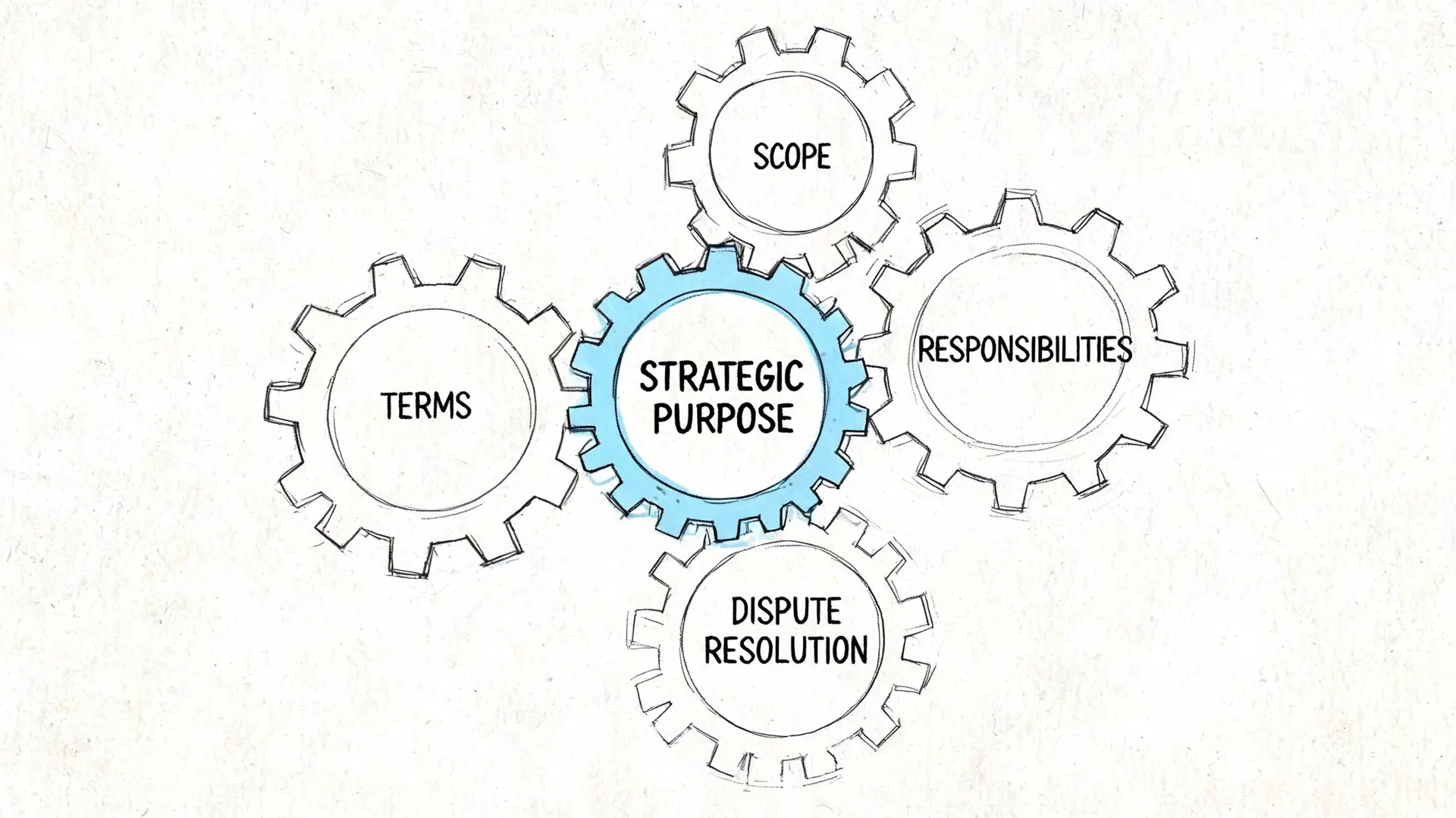
A professional strategic partnership agreement template starts with five essential elements. According to PandaDoc’s breakdown of strategic partnership agreements, those elements are the parties involved, the services to be performed, the financial terms, the reporting structure, and the duration of the agreement. Best practice also requires liability, dispute resolution, and dissolution clauses.
The five clauses that carry the structure
Those five elements look basic because they are basic. Yet each one carries strategic weight.
-
Parties involved. Full legal names, locations, and principal contacts do more than identify the signatories. They establish who can bind the organization, who receives notices, and which affiliate is actually exposed if the relationship fails.
-
Services to be performed. This clause should separate obligations, dependencies, and deliverables. If one side handles product localization, channel access, compliance support, or technical integration, the agreement must say so with enough detail that operations teams can execute without guessing.
-
Financial terms. Revenue splits, billing mechanics, reimbursement categories, audit rights, and timing rules belong here. Vague economic language creates future advantage for the wrong reasons.
-
Reporting structure. This section determines who speaks for each side after signature. It should identify working contacts, escalation contacts, and how information moves upward.
-
Duration. Effective date, renewal logic, termination triggers, and post-termination duties belong here. Deals rarely fail because the opening term was wrong. They fail because the exit rules were thin.
A useful primer on how to form a business partnership helps frame these foundation questions in business terms before legal drafting begins.
What boilerplate must actually do
Boilerplate isn’t harmless filler. In partnership work, boilerplate decides whether the skeleton can bear weight.
Consider the clauses below.
| Clause area | What works | What fails |
|---|---|---|
| Liability | Clear allocation by category of loss and defined exclusions | Broad language that sounds protective but leaves commercial gaps |
| Dispute resolution | A staged process with deadlines, forum clarity, and interim relief rights | A single sentence forcing parties into a forum no one tested |
| Dissolution | Operational unwind steps, customer handling, data return, and IP separation | A termination right with no exit mechanics |
Practical rule: If a clause can’t guide management during conflict, it isn’t finished.
Turn the template into an operating document
The best agreements don’t stop at legal nouns. They assign real work.
That means the document should attach practical schedules. Examples include an approvals matrix, service descriptions, reporting forms, and launch priorities. A template that leaves these items for later usually creates costly ambiguity later.
Many executives ask for a “short form” first. That’s reasonable at the term-sheet stage. It becomes dangerous when short form drafting survives into execution, because the unresolved details tend to reappear as disputes over authority, money, or ownership.
Aligning Goals to Prevent Failure
Many partnership documents fail before the first draft leaves legal. The parties haven’t agreed on what success means.
That error is more than tactical. It is one of the clearest predictors of failure. According to Breezy’s analysis of strategic partnership development, strategic partnership agreements fail at rates of 60-70%, and 35% of managers in failed joint ventures cite misaligned goals. The same source states that partnerships with clear metrics succeed 40% more often.
The contract should record shared intent
Most executives say they want growth, market access, innovation, or scale. Those statements are too broad to govern behavior. A partnership agreement should convert them into obligations, review points, and decision thresholds.
That begins before drafting. The negotiating team should hold structured pre-negotiation workshops with business, finance, operations, product, and legal representatives. If leadership negotiates alone, it often secures an elegant deal that operating teams cannot deliver.
A useful non-legal complement is The OKR Hub’s alignment insights, which show why strategic alignment breaks when teams define objectives at different levels of specificity.
A practical alignment method
The agreement should reflect a disciplined process, not hopeful language.
-
Define the shared objective first. State the commercial purpose in plain language. Is the alliance meant to open the Israeli market, co-develop a product, or combine channels with technology?
-
Translate that objective into measurable KPIs. The source above points to KPIs such as revenue growth, customer acquisition rates, and market share expansion. The key isn’t the label. The key is that both parties accept how performance will be measured.
-
Map operational ownership. Every KPI should have an owner on each side. If no owner exists, the KPI is decorative.
-
Record review rights and correction rights. The contract should say when performance is reviewed, who attends, what information is exchanged, and what happens if targets drift.
-
Add contingency terms. IP protection, exit triggers, and cultural fit reviews shouldn’t sit outside the alignment process. They are part of it.
When parties avoid hard conversations in negotiation, they invite hard disputes in execution.
What weak alignment looks like in practice
Weak drafting often uses phrases such as “use reasonable efforts to promote cooperation” or “work together to expand the market.” Those words may have diplomatic value. They rarely control a strained relationship.
A stronger clause identifies the market scope, the commercial milestones, the reporting cadence, and the cure process. It also states whether missed targets trigger renegotiation, exclusivity review, reduced commitments, or termination rights.
For cross-border deals involving Israel, alignment also requires legal-cultural realism. Israeli business teams often move quickly and expect direct communication. Foreign counterparties may rely on slower approval chains and layered committee review. The agreement should absorb that difference with explicit authority lines and response timelines. Otherwise, both sides may accuse the other of bad faith when the actual problem is incompatible operating rhythm.
Navigating Cross-Border Legal Minefields
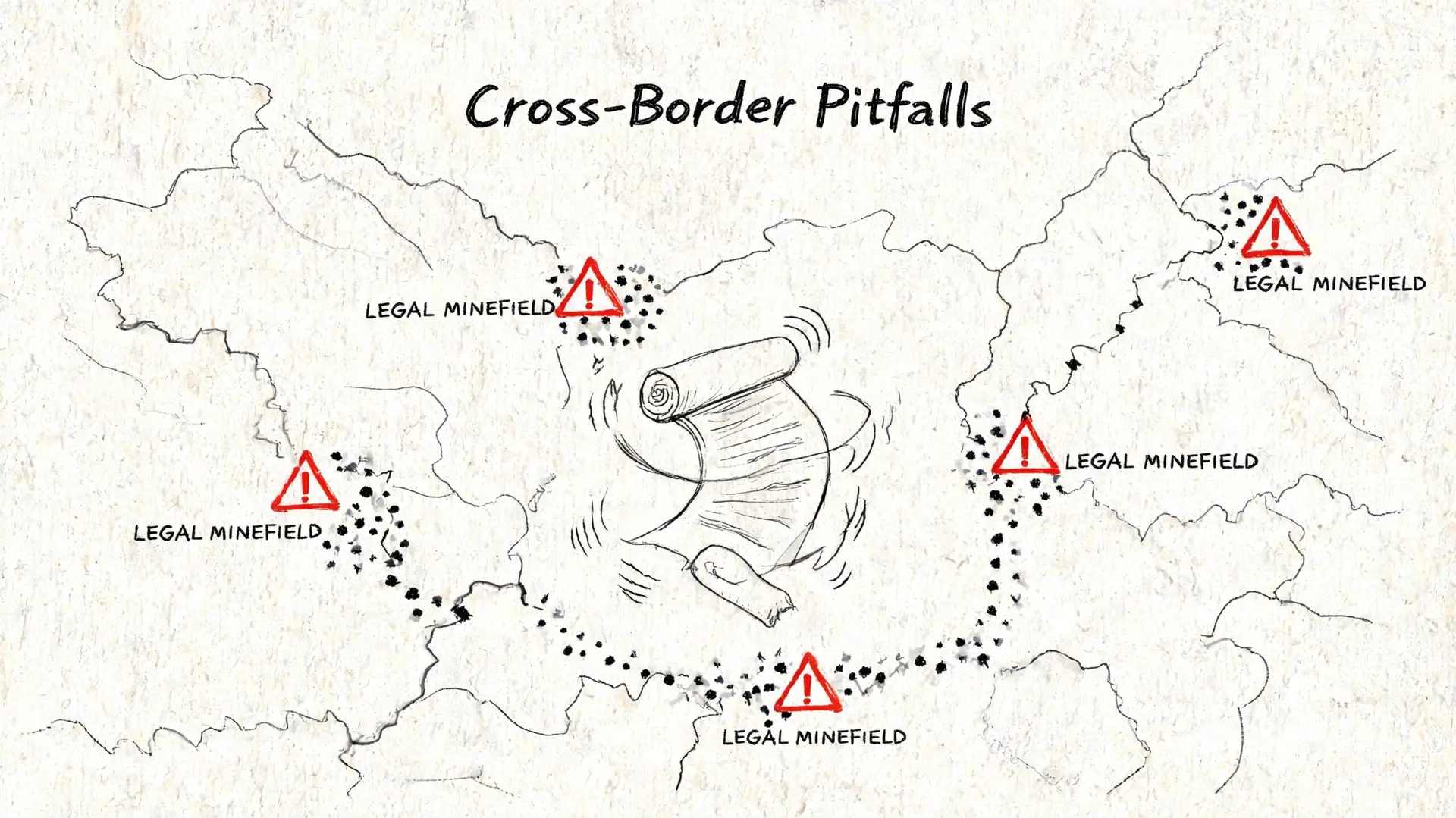
What happens when a generic partnership template drafted for a domestic deal is used for a cross-border venture touching Israel, and the first real test is a supply shock, regulatory restriction, or public conflict between the parties?
The problem is rarely the headline economics. The problem is that the template assumes one legal system, one enforcement culture, and one crisis pattern. Cross-border deals do not behave that way. A clause that looks acceptable in a standard form can fail under pressure if performance sits in Israel, management sits elsewhere, and the parties have not agreed on where emergency relief is sought, which language controls, or what happens when operations are disrupted for reasons that fall into the grey area between force majeure and commercial hardship.
I have seen this play out in an anonymized Israel-related distribution dispute. The agreement used foreign governing law, named arbitration, and included a force majeure clause copied from an older template. It did not deal clearly with interim injunctive relief, customer communications, or inventory control during disruption. When regional events interrupted supply, one side treated exclusivity as suspended. The other treated exclusivity as intact and accused its partner of a disguised termination. Before the merits were even argued, the parties were fighting over forum, urgent remedies, and who could contact key accounts. That is what weak cross-border drafting looks like in practice. The legal clause fails first. The commercial relationship fails next.
Choice of law is a risk allocation decision
The governing law clause should match the deal’s operating reality and dispute strategy. If the partnership will be performed in Israel, supervised by an Israeli team, or dependent on Israeli customers, assets, data, or personnel, the parties need to test whether the chosen law will support the remedies they are likely to need.
That review should cover at least five points:
- Governing law. Choose the law that best fits the transaction and the likely breach scenario, not the law that feels familiar in the boardroom.
- Dispute forum. Decide whether court litigation, arbitration, or a tiered process will produce a faster and more enforceable result.
- Interim relief. State where a party may seek injunctions, evidence preservation, or asset protection before the final forum is constituted.
- Enforcement path. Check early how a judgment or arbitral award will be recognized where the counterparty, records, or assets are located.
- Controlling language. Bilingual deals need a clear hierarchy. Otherwise, the translation dispute can overtake the business dispute.
These are drafting choices with direct commercial consequences. They determine whether a party can stop misuse of IP, freeze a damaging account transfer, preserve evidence, or keep a local team from acting outside authority during a crisis.
Arbitration helps only if the clause anticipates conflict under pressure
Arbitration is often sensible for cross-border partnerships involving Israel. It can offer neutrality, confidentiality, and a cleaner enforcement route in the right case. It also creates delay and satellite disputes if the clause is thin.
A workable arbitration clause usually identifies the seat, rules, language, number of arbitrators, consolidation rights, treatment of affiliates, and availability of emergency relief. It should also state whether either party may apply to local courts for urgent interim measures without breaching the arbitration agreement. If that point is omitted, the first weeks of a serious dispute can be wasted on procedural arguments while customers, inventory, and market position move out of reach.
The operational side matters too. Teams that want to reduce that delay should build approval paths, notice triggers, and escalation records into their contracting process. This guide on how to build contract workflow automation is useful for that reason. It addresses the internal process discipline that keeps dispute clauses usable when time is short.
Force majeure must be drafted for regional reality
A generic force majeure clause is not enough for an Israel-facing deal. Listing war, terrorism, strikes, or government action does not answer the questions that matter once disruption starts.
The contract should say whether minimum purchase commitments pause, whether exclusivity survives, whether payment obligations continue for delivered goods or services, who controls inventory already in country, how substitute performance is approved, and when prolonged disruption becomes a termination right rather than an indefinite suspension. It should also assign responsibility for customer messaging, data access, record retention, and regulator contact where relevant.
For higher-risk sectors, legal drafting should sit inside a broader commercial crisis management strategy. That is where many generic templates fail. They treat force majeure as a boilerplate excuse clause. In a cross-border Israel deal, it is part of the operating model for stress events.
A CEO should press one final point before signing. If the relationship turns hostile during a regional disruption, who controls the customers, the local files, the branded materials, and the public narrative? If the agreement does not answer that with precision, the stronger operator on the ground usually answers it first.
Building Active Governance and Implementation

The signature page doesn’t secure the deal. The management system after signature does.
That distinction separates partnership documents that live from those that gather dust. According to IMD’s work on strategic partnerships, 60% of executives report positive outcomes when following a rigorous implementation framework. That framework includes a joint steering committee, a KPI dashboard, and clear performance evaluation cadence.
Governance should be active, not ceremonial
A joint steering committee must have actual authority. If it only receives updates, then real power sits elsewhere and the committee becomes theatre.
Effective governance usually includes the following:
- Defined decision rights. Which issues require unanimous approval, majority approval, or executive escalation.
- Escalation architecture. If the working team stalls, the agreement should push the issue upward on a fixed timeline.
- Meeting discipline. Regular agendas, attendance rules, minutes, and action tracking.
- Reserved matters. Budget changes, exclusivity shifts, product changes, or market expansion should trigger specific approvals.
Teams that want to operationalize this discipline often benefit from learning how to build contract workflow automation, especially where approvals and reporting already move through digital systems.
The dashboard must match the bargain
Many partnerships use generic scorecards. That weakens accountability because the dashboard stops reflecting the actual contract.
A sound dashboard should track the commercial purpose of the alliance. If the deal is channel-driven, monitor pipeline quality, conversion behavior, and partner-led account activity. If the deal is product-driven, monitor development milestones, testing signoffs, and launch dependencies. The legal document should specify not only what gets measured, but who supplies the data and who can challenge it.
A short implementation schedule often helps more than a long legal recital. It can include launch tasks, owner names, deadlines, and dependencies. That schedule turns an abstract strategic partnership agreement template into a practical execution tool.
Financial controls deserve legal attention
Partnerships often collapse over cash handling long before they collapse over strategy. Billing delay, unapproved expense allocation, or poor treasury coordination can trigger broader conflict.
That is why the agreement should define invoicing procedure, documentary support, reconciliation rights, withholding treatment, and who controls customer collections. If financial controls are weak, the legal dispute can spill into account restrictions, payment freezes, and reputational stress. In difficult cases, executives should understand the commercial consequences that can arise from bank account blockages and related restrictions.
Good governance reduces the number of disputes that ever become legal disputes.
Adapting Key Clauses for Your Agreement
What happens when a standard template meets a real cross-border crisis?
The answer usually appears in the clauses management assumed were “standard.” In Israel-facing partnerships, that is where generic drafting often fails. A clause that reads well in a template can break down once the parties face export control questions, sanctions exposure, IP ownership disputes, emergency injunctions, tax withholding friction, or a sudden need to suspend performance without destroying the wider relationship.
Each core clause should be adjusted to the commercial structure, the jurisdictions involved, and the failure scenario that would hurt most.
Governance clause
Sample concept
The parties shall establish a joint steering committee composed of designated business representatives from each party. The committee shall review performance, approve agreed reserved matters, supervise implementation issues, and escalate unresolved disputes to named senior executives in accordance with the timetable set out in the schedule.
This clause needs more than a committee title. It should state who can bind each party, which decisions require unanimity, which can be approved by a simple majority, and what happens if the committee deadlocks during an operational emergency. In cross-border deals, especially those involving Israeli companies with fast product cycles or security-sensitive operations, delay can be as damaging as disagreement.
I often add an emergency decision protocol. If a cybersecurity event, regulatory notice, supply interruption, or reputational incident occurs, the contract should identify who has temporary authority to act, how quickly notice must be given, and when the steering committee must ratify or reverse that action. Without that mechanism, the party that moves first may later be accused of overreach, while the party that waits may be blamed for avoidable loss.
Intellectual property clause
Sample concept
Each party retains ownership of its pre-existing materials, technology, know-how, data, trademarks, and other background intellectual property. Intellectual property created jointly in the course of the collaboration shall be owned, licensed, or allocated according to the specific workstream schedule, together with rights of use after termination.
The essential work lies in the definitions and the fallbacks. Israeli technology partnerships often involve a mix of legacy code, founder know-how, customer data, locally developed improvements, and deliverables created by contractors rather than employees. A generic template rarely deals with that mix cleanly.
The agreement should separate background IP, project IP, derivative works, data sets, and usage rights by territory, field, and duration. It should also address who can register rights, who pays for prosecution and enforcement, and whether one party can continue using jointly developed outputs after termination. If those points are left vague, the dispute will not stay academic. It will affect product releases, investor diligence, and bargaining power in the next financing or acquisition process.
Dispute resolution clause
Sample concept
The parties shall first submit any dispute to designated executives for good-faith resolution within a defined period. Failing settlement, the dispute shall proceed to the agreed forum, with express preservation of rights to seek urgent interim relief where confidential information, customer relationships, or intellectual property are at risk.
For a domestic contract, that structure may be enough. For a cross-border alliance, it usually is not. The clause should answer harder questions. Which law governs interim relief? Can a party seek injunctions in Israel while arbitrating elsewhere? Will a foreign judgment or arbitral award be enforceable where the counterparty’s assets, bank accounts, or core personnel are located?
Those are not drafting details. They determine whether the stronger legal position can be enforced under pressure.
The escalation period also needs discipline. A long executive negotiation window may preserve the relationship in a low-grade dispute, but it can be dangerous during misuse of confidential information, channel conflict, or diversion of a major customer opportunity. Good drafting distinguishes between disputes that require a short business cure period and disputes that justify immediate recourse to court or arbitration.
Term and exit clause
Termination language should allocate the breakup with the same care used to document the launch.
That includes customer communications, transition services, return or deletion of sensitive materials, treatment of live opportunities, completed but unpaid work, sublicenses, inventory, and post-termination restrictions on use of shared branding or confidential information. In Israel-related deals, I also want the contract to state what happens if legal or regulatory conditions change abruptly, including restrictions affecting performance, payments, data transfers, or market access.
The same drafting discipline appears in other complex commercial contracts, including commercial lease agreements, where termination mechanics often determine who carries the financial and operational pain after the relationship stops working.
A useful exit clause does not just end the partnership. It contains the damage, preserves evidence, protects revenue where possible, and reduces the chance that a commercial dispute turns into a multi-jurisdiction enforcement fight.
Conclusion and Next Steps
A strategic partnership agreement template can be useful, but only as a starting framework. It becomes dangerous when management treats it as a finished instrument for a serious Israeli or international deal.
The right agreement must do three jobs at once. It must capture the bargain, govern the relationship, and survive cross-border stress. That requires more than standard clauses. It requires deliberate choices about objectives, metrics, authority, IP, enforceability, and exit.
For CEOs and in-house counsel, the practical lesson is straightforward. If the partnership matters commercially, then the contract must be drafted as if conflict is possible, execution will be messy, and cross-border enforcement may become necessary. That isn’t pessimism. It’s disciplined transaction design.
The recommended strategic path is to review any proposed template before commercial terms harden, pressure-test the cross-border clauses early, and build a governance structure that management can effectively use. Waiting until signature week usually leaves too little room to correct structural errors.
Avoid costly mistakes and get a strategic review before a template becomes a dispute. Contact RNC Group now for guidance on high-stakes Israeli and cross-border commercial partnerships.
This article provides general information only. It does not constitute legal advice, does not create an attorney-client relationship, and should not be relied on as a substitute for advice on specific facts, jurisdictions, or transactions.