
A foreign company often asks the wrong opening question. It asks whether a cease and desist letter is enforceable, when it should ask what strategic position that letter creates in Israel, especially in a cross-border dispute.
That distinction matters more in 2026. A routine marketing launch, distributor conflict, licensing breach, or brand rollout can trigger a notice that affects negotiations, banking relationships, counterparties, and market-entry timing long before any judge sees the file.
Is Your Global Brand Compliance Ready for Israel in 2026
What happens when a global campaign clears internal review in London, New York, or Singapore, but collides with Israeli commercial reality on day one?
For many foreign businesses, the first legal shock isn’t a lawsuit. It’s a sharply drafted demand letter that arrives just as a product launch, franchise rollout, or partnership announcement goes live.

Under projected 2026 changes, Israeli procedure has become more exacting for foreign market participants in adjacent commercial settings. For example, analysis of Israeli government tender rules for 2026 notes that many tenders now require a verifiable Israeli address or a formal local representative agreement. That procedural tightening reflects a wider point. Israel rewards preparation, local documentation, and clean lines of authority.
The real exposure isn’t always deliberate misconduct
Most executives still treat a cease and desist notice as a nuisance. That reading is usually wrong.
In practice, the letter often marks the first controlled move in a broader escalation plan. The sender may be testing speed, influence, document quality, and willingness to negotiate. In Israel, those issues often connect to distribution chains, Hebrew and English contract interpretation, passing off allegations, copyright ownership, and post-termination conduct.
A common trigger is branding drift. Teams borrow visual language, claims, or channel language from international campaigns without checking local rights. Reviewing practical references such as Moonb’s brand guideline examples can help businesses understand how tightly brand assets should be governed across markets, especially when local resellers or agencies adapt materials without legal review.
A cease and desist notice doesn’t simply ask a company to stop. It tests whether the company controls its own commercial footprint.
Why 2026 raises the stakes
The legal question isn’t only what is cease and desist in the abstract. The serious question is whether the company can answer a demand with records, authority, and a coherent position.
That is where many international businesses lose time. They have contracts, but not signed versions. They have brand rules, but no local approval trail. They have rights, but no Israeli-facing evidence file.
Decoding the Cease and Desist Notice
What is a cease and desist notice in legal reality, especially if your business operates across borders and the dispute lands in Israel?
A cease and desist letter is a formal demand that alleges misconduct and tells the recipient to stop specific conduct, take corrective steps, preserve rights, or address claimed damage. In cross-border commercial disputes, it also serves a second function. It defines the sender’s theory of the case before anyone reaches court.
That matters because Israeli disputes often turn on points foreign companies underestimate at the outset. The disputed conduct may involve Hebrew and English materials that do not match, local distributor conduct the parent company did not fully supervise, or IP rights held by one group entity while another entity sent the notice. The letter is often the first document that tries to impose order on that confusion.
Letter versus court order
A cease and desist letter works as a formal warning. A court order creates enforceable obligations.
The distinction is simple, but the strategic consequences are not. A letter does not carry automatic judicial force. It does, however, put the recipient on notice, frame the factual record early, and create a document that may later be attached to an injunction application, a damages claim, or a settlement file. In Israeli practice, that early record can shape how a judge views urgency, reasonableness, and post-notice conduct.
| Issue | Cease and desist letter | Court order |
|---|---|---|
| Legal status | Private legal demand | Binding and enforceable |
| Immediate effect | Puts the dispute on record | Requires compliance |
| Strategic impact | Stakes out claims and pressure points | Changes legal obligations at once |
| Typical purpose | Notice, pressure, settlement positioning | Injunction, restraint, compliance |
Corporate teams often miss the commercial point. The sender may be trying to stop market confusion, freeze a damaging narrative, pressure a distributor, or create a record for later proceedings in Israel or elsewhere.
Why lawyers send them early
Good counsel sends a notice early to gain procedural and commercial advantage.
A well-timed letter can pin down dates, identify the alleged breach, demand preservation of evidence, and test whether the other side has decision-makers in control. In matters involving trademark use, software ownership, confidential information, unfair competition, or terminated distribution rights, that timing affects settlement posture. It also affects whether the dispute can be contained before customers, regulators, counterparties, or the Israeli press become involved.
In serious matters, the notice is part of crisis management as much as legal process.
Practical rule: Read the letter as both a legal demand and a calibrated attempt to control the next phase of the dispute.
What recipients often misunderstand
A common mistake is to assume there are only two choices: comply immediately or ignore the letter.
Both responses can be expensive. Immediate compliance may concede legal points your business has not tested, disrupt operations, or prejudice claims against a local partner. Ignoring the letter can strengthen an application for interim relief and make later explanations look engineered after the fact.
The better first step is classification. Identify the exact conduct challenged. Match it against the governing contracts, IP registrations, reseller arrangements, and internal approvals. Then assess whether the sender has a legal basis that can be enforced in Israel, or whether the letter overstates a commercial complaint in legal language.
That assessment should happen quickly, but not casually. In cross-border disputes, speed without structure creates avoidable mistakes.
Anatomy of a Strategic Israeli Demand Letter
What separates a letter that gets ignored from one that changes the other side’s risk calculation by tomorrow morning?
In Israel, the answer is rarely volume or rhetoric. It is whether the notice is built to support the next step if the dispute escalates. For international businesses, that means a demand letter must do two jobs at once. It must pressure the recipient commercially and hold up later before an Israeli judge, arbitrator, regulator, insurer, or counterparty reviewing the paper trail.
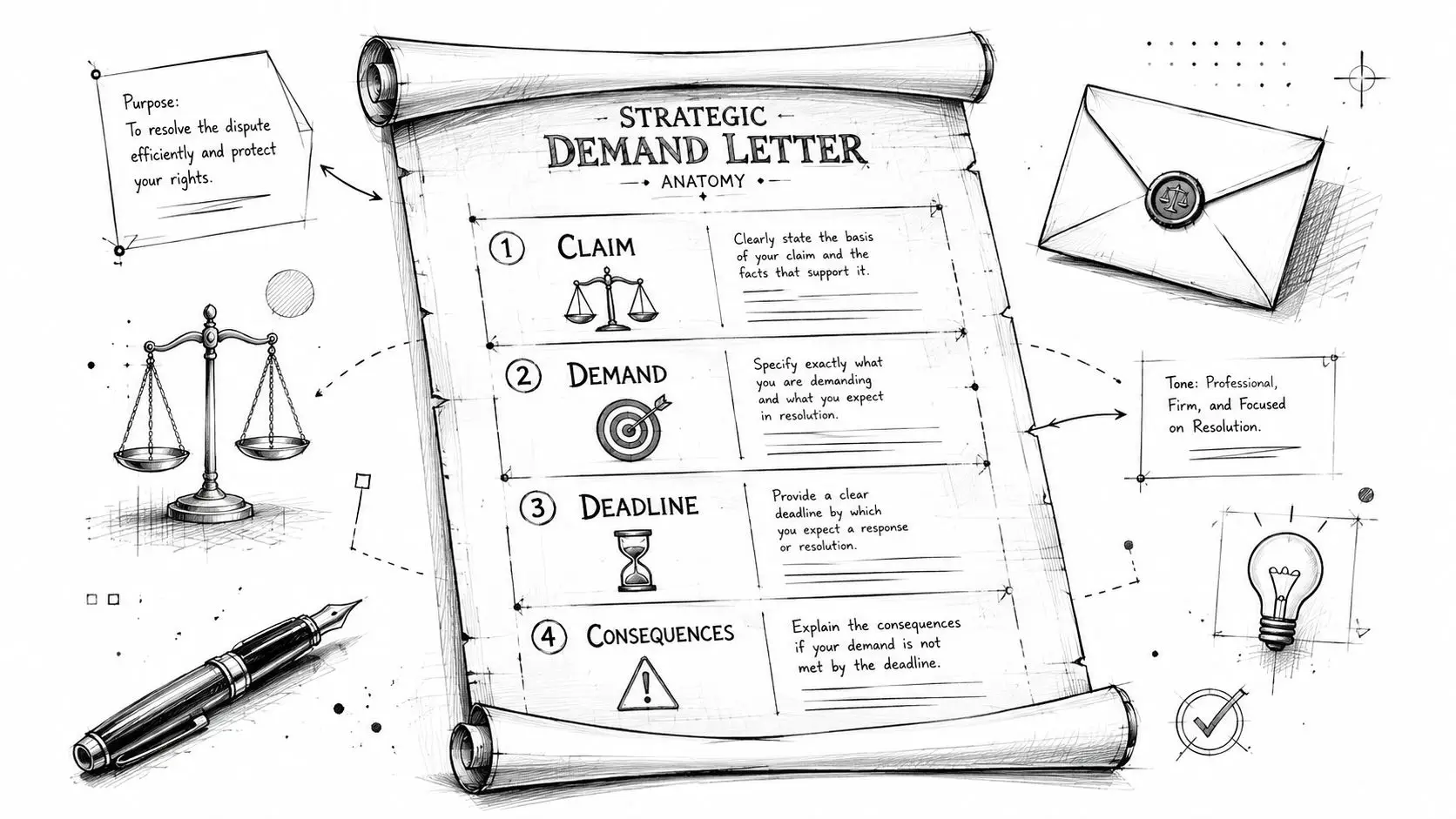
Identification and authority
Start with ownership, authority, and enforcement posture.
That sounds obvious. In cross-border matters, it often is not. The IP may be held by a Dutch parent, licensed through a UK affiliate, and commercialized in Israel through a local distributor whose contract was amended three times. If the sender cannot show who owns the right, who was harmed, and who is entitled to demand relief, the letter invites resistance instead of compliance.
A well-drafted notice resolves that problem on the first page. It identifies the relevant entities, the operative agreements, and the basis for standing under the actual transaction structure.
Facts that can survive scrutiny
The factual section is not background. It is record creation.
The strongest Israeli demand letters use facts that can be proved quickly: dates, screenshots, purchase orders, registrations, termination notices, product listings, campaign copies, metadata, and correspondence with the local business team. In urgent matters, that discipline matters because facts stated loosely in a letter often reappear later in affidavit form. If the first version is overstated, counsel spends the next phase explaining avoidable inconsistencies.
In commercial lease or occupancy disputes, for instance, a notice tied to commercial lease agreements in Israel carries weight only if it tracks the executed lease, notice mechanics, exclusivity terms, default provisions, and the actual use of the premises.
Legal basis and commercial objective
Good letters do not recite every claim counsel can imagine. They choose the claims that fit the evidence and support the business objective.
That distinction matters in Israel. A letter sent only to sound aggressive often reads badly to discerning recipients and even worse in later proceedings. The better approach is to align the legal theory with the pressure point. In one matter, the right answer is trademark infringement and passing off. In another, the stronger route is breach of exclusivity, misuse of confidential information, interference with customer relationships, or post-termination restrictions. The recipient should understand not only what rule was breached, but why the conduct creates immediate exposure in the Israeli market.
For non-lawyers inside the company, the structure should also be legible as a formal legal instrument. The SendItFax guide to legal documents gives a useful general reference point on what makes a document legally binding. The practical point here is narrower. A demand letter is strongest when legal form, documentary support, and escalation options line up.
Demand, deadline, and proof of compliance
The demand must be specific enough to enforce and realistic enough to test.
A serious Israeli notice states what conduct must stop, what content must be removed, what inventory must be quarantined, what undertakings must be signed, and what proof must be delivered. It also sets a deadline tied to the actual risk. A counterfeit listing harming online sales may justify a short turnaround. A dispute over channel rights or software scope may require a slightly longer period so the parties can preserve evidence and assess contractual dependencies.
The deadline is not clerical. It marks the point at which the sender can say the recipient had notice, had time to assess, and chose its position.
What works in practice
The letters that produce movement usually share the same features:
- Clear ownership and authority, with the right entities named
- Facts that can be exhibited later without retreat or correction
- Legal claims selected for fit, not for theatrical effect
- Demands tied to concrete actions and verifiable compliance
- A deadline calibrated to the business harm and the likely next application in Israel
- An off-ramp that allows resolution without unnecessary public escalation
What fails is also predictable. Template threats copied from another jurisdiction. Translated notices that ignore Israeli procedure or local commercial realities. Claims inflated beyond the evidence. Demands so vague that the recipient can respond with apparent cooperation while preserving the disputed conduct.
That is the gap between common perception and legal reality. Many businesses treat the demand letter as a warning shot. In high-stakes Israeli disputes, it is often the first exhibit in a broader enforcement strategy.
Legal Effect in Israel and International Disputes
Foreign companies often assume legal effect turns only on formal enforceability. That assumption overlooks the actual litigation risk.
In Israel, as in other serious commercial forums, the important question is often whether the notice created a documented moment of awareness and forced the recipient to choose a path.
Formal weakness, practical force
A cease and desist letter isn’t self-executing. It doesn’t, by itself, compel performance.
Yet the strategic force can be considerable, especially in intellectual property disputes. As explained in the New York courts legal research note on cease and desist letters, ignoring a cease-and-desist letter can constitute evidence of willful infringement in IP litigation, significantly increasing monetary damages. The same source notes that 68% of IP plaintiffs cite receipt of a cease-and-desist letter as a factor in determining willful damages in federal court.
That point matters in cross-border disputes involving Israeli operations, local distributors, online targeting, or multilingual advertising. A foreign company may believe it is buying time by staying silent. Instead, silence may later be characterized as informed continuation.
Why cross-border assumptions fail
General business guides often blur the difference between a legally binding document and a strategically dangerous one. For executives who want a plain-language comparison, the SendItFax guide to legal documents is a useful baseline. It helps distinguish enforceability from evidentiary and transactional weight.
That distinction becomes sharper in international matters. A notice may be weak on one issue and still powerful on another. It may not compel immediate compliance, yet it may influence settlement dynamics, interim applications, insurance reporting, board disclosures, and preservation duties.
Israeli context and local structuring
Israel doesn’t reward generic responses. Courts and counterparties look closely at actual rights, actual conduct, and actual documentation.
That local precision shows up in other corporate settings too. For example, Chambers’ Israel M&A guide notes that for Israeli public companies, a reverse triangular merger is the only viable acquisition structure because tender offer rules mandate that holders of no less than 95% of the target company’s shares must accept the offer. The larger lesson is straightforward. Israeli law often turns on specific procedural architecture, not broad commercial intuition.
A cross-border dispute in Israel rarely fails because a party lacked confidence. It fails because the party used the wrong legal map.
Your Strategic Response Playbook When You Receive a Notice
The first response often determines whether the matter remains manageable. It can also determine whether the company preserves its advantage or loses it before counsel begins substantive analysis.
That is why the company should treat the notice as a crisis-management event, not as ordinary inbox traffic.

Immediate actions that reduce risk
-
Stop the reflex response.
Executives often want to call the sender, deny the claim, or promise quick fixes. That is usually a mistake. Early statements can create admissions, inconsistencies, and unnecessary commitments. -
Preserve records at once.
Save contracts, emails, drafts, invoices, screenshots, approvals, agency instructions, and internal messaging. Preserve both English and Hebrew materials if both exist. The factual record often decides whether the issue is infringement, misunderstanding, or a contract-performance dispute. -
Map the allegation to the business unit.
Identify who launched the campaign, signed the agreement, approved the artwork, ran the website, or negotiated the channel relationship. Legal review works faster when the operational owner is clear.
Silence inside the company is as dangerous as silence toward the sender. Someone must own the factual investigation immediately.
Digital delivery counts
Many foreign companies still expect formal legal correspondence to arrive as a printed letter from a law office. That assumption is outdated.
According to Heer Law’s discussion of cease and desist delivery methods, a 2025 analysis by the International Association of Copyright Lawyers found that 42% of cease-and-desist notices in cross-border disputes were delivered digitally. The same source explains that these non-traditional formats can carry equal legal weight. An email, platform message, or other digital communication may therefore trigger the same strategic obligations as a traditional letter.
Internal response checklist
- Secure the evidence file: Collect source files, approval chains, contracts, and prior correspondence in one controlled repository.
- Pause unnecessary changes: Don’t destroy content, delete posts, or rewrite agreements impulsively. Controlled interim measures are different from panic edits.
- Check adjacent exposures: A branding dispute can expand into payment holds, distributor friction, or account access issues. Businesses already managing operational stress should understand how legal pressure can intersect with bank account blockages in Israel.
- Assign one response channel: Mixed replies from marketing, sales, founders, and outside agencies create avoidable damage.
- Escalate as a managed event: If the issue threatens reputation, counterparties, or regulatory optics, it belongs inside a broader crisis management framework, not a narrow legal silo.
What a disciplined response looks like
A disciplined response does not always mean refusal. It means informed positioning.
Sometimes the right move is a denial supported by documents. Sometimes it is a temporary standstill while facts are checked. Sometimes it is a commercial proposal that narrows the dispute without conceding liability. The point is sequence. Investigate first, speak second, commit last.
Sending a Notice as a Tool for Escalation Control
From the sender’s side, the value of a cease and desist letter lies in control.
A business that has spotted infringement, contractual breach, misuse of confidential material, or channel interference usually wants three things. It wants the conduct to stop, the evidence preserved, and the dispute framed on advantageous terms.
Why a strong notice can prevent a worse fight
A carefully drafted letter often accomplishes more than a rushed court filing. It gives the sender room to demand immediate correction while preserving flexibility on settlement, licensing, revised performance, or structured withdrawal.
That is one reason practitioners use the letter as an opening move rather than a symbolic gesture. According to Davis Business Law’s guide to cease and desist letters, a cease and desist letter serves as a de-escalation tool that can resolve conflicts through negotiation before they reach court. It is often the quickest and easiest method to settle matters while avoiding costly and time-consuming litigation by establishing prior notice of the alleged misconduct.
What strategic senders do differently
They don’t send a generic threat and hope fear does the rest. They build the letter around the recipient’s actual pressure points.
That may mean focusing on channel misuse in a franchise network, unauthorized marketing in Israel, post-termination solicitation, or copyright ownership in multilingual content. In each case, the letter should do more than accuse. It should create a rational path for compliance.
| Sender objective | Better approach | Poor approach |
|---|---|---|
| Stop harmful conduct | Define exact acts that must stop | Use vague, broad demands |
| Protect future claims | Document prior notice clearly | Rely on verbal complaints |
| Open settlement space | Offer a structured off-ramp | Demand total capitulation |
| Prepare for escalation | Align facts, rights, and timing | Send before evidence is ready |
Good legal correspondence reduces uncertainty for the sender and increases decision pressure for the recipient.
When not to send one
A notice isn’t always the right first step. If evidence is incomplete, if notice could trigger asset movement, or if surprise is vital to an interim remedy strategy, counsel may choose a different sequence.
Still, in many Israeli commercial disputes, the demand letter remains the best opening move because it clarifies the battlefield without forcing immediate litigation.
Conclusion Your Next Move to Avoid Costly Mistakes
A cease and desist notice is not a procedural formality. It is a strategic event.
For international businesses operating in or into Israel, that event usually arrives at a commercially sensitive moment. The dispute may involve branding, copyright, contractual performance, distributor conduct, digital communications, or market-entry friction. The legal issue matters, but the operational timing often matters just as much.

The practical answer to what is cease and desist is therefore broader than a dictionary definition. It is a formal demand that may lack self-executing force, yet still shape evidence, negotiation advantage, business continuity, and cross-border litigation posture. Companies that treat it casually often create avoidable exposure. Companies that treat it strategically preserve options.
To avoid costly strategic mistakes and ensure commercial interests remain protected, the recommended path is to seek expert counsel immediately. Contact our firm now to design a strategic response.
Disclaimer: This article provides general information for educational purposes only. It does not constitute legal advice and should not be relied upon as such. Every legal situation is unique, and you should consult with a qualified attorney regarding your specific circumstances before taking any action. Reliance on any information provided in this article is solely at your own risk.
RNC Group handles high-stakes Israeli and cross-border commercial disputes with a strategy-first approach that prioritizes control, speed, and risk containment. Businesses that want to avoid costly mistakes and assess the right next move can contact RNC Group.