
A cross-border lease rarely fails because the rent clause was missing. It usually fails because the dispute clause looked harmless, the notice mechanics stayed vague, and the business team assumed any serious problem could wait for local counsel after the fact.
That assumption creates risk in Israel. A lease dispute can interrupt operations, strain lender relationships, and force executives into a forum they didn’t choose. For a multinational group, commercial lease dispute resolution isn’t a paperwork issue. It’s a control issue.
Is Your 2026 Lease Agreement a Ticking Clock
Many foreign companies still treat dispute clauses as boilerplate. That is the mistake. In a high-value lease, the dispute clause decides who moves first, who sets the timetable, and who absorbs pressure while the argument unfolds.
The global context matters. The International Chamber of Commerce reported that the average amount in dispute in new cases in 2023 was US$65 million in its dispute-resolution system, which shows how commercial conflicts often sit far beyond routine local disagreements under the ICC’s 2023 dispute resolution statistics. Lease disputes can fit that same profile when the site is operationally critical, the brand is exposed, or multiple jurisdictions sit behind one tenancy structure.
Executives who track occupancy strategy often focus on expansion metrics and market timing. They should also review broader growth insights for major landlords, because those same market pressures often harden landlord positions during defaults, rent reviews, and renewal conflicts.

Why the real risk hides in process
A lease dispute in Israel can involve rent escalations, maintenance responsibility, renewal rights, service charges, fit-out obligations, or termination triggers. None of those issues stays isolated for long. Once notice periods start running, the legal question and the business crisis become the same problem.
Practical rule: If the lease doesn’t tell the parties exactly how a dispute escalates, the stronger party usually writes the process in real time.
That is why experienced tenants and landlords no longer ask only, “Which court has jurisdiction?” They ask harder questions.
- Who must respond first: A defined response window prevents tactical silence.
- What must be exchanged: Documents, ledgers, notices, and inspection material should move early.
- When executives step in: Senior escalation often resolves what lawyers cannot.
- What happens if settlement fails: The fallback route must be explicit.
A lease that ignores those questions isn’t flexible. It’s exposed.
Mapping the Core Resolution Mechanisms
In practice, most commercial lease disputes don’t start in court. They move through increasingly formal stages. The right mechanism depends on bargaining power, urgency, confidentiality, and the value of the ongoing relationship.
According to the American Arbitration Association, commercial arbitration and mediation are designed to help businesses resolve disputes efficiently and fairly, with case administration support throughout the process within AAA’s commercial dispute framework. In major commercial markets, ADR has become the dominant path. Arbitration can offer a faster and more affordable route than litigation, while mediation often suits disputes where the parties still need to work together.
Negotiation and mediation
Negotiation is the first useful tool if the parties still control communication. It works best when the dispute turns on accounting adjustments, cure periods, temporary access issues, or short-term operational fixes. It fails when one side needs precedent, publicity, or immediate coercive relief.
Mediation introduces a neutral without giving up control of the outcome. That matters in leases where both sides want continuity, such as a tenant that still needs the premises or a landlord that wants occupancy preserved. Mediation is non-binding, which is its strength and its weakness. It permits customized settlements, but it cannot force an unwilling party to perform.
Mediation works when both sides need a deal more than they need a public victory.
Arbitration and litigation
Arbitration is private adjudication. It makes sense when the parties need a binding decision, want confidentiality, and prefer a specialist decision-maker rather than a public court track. It often suits interpretation disputes, rent and charge calculations, default claims, and cross-border enforcement planning.
Litigation remains essential in some cases. Israeli court proceedings may be the only realistic choice where urgent injunctions, possession issues, or third-party claims require judicial powers that private ADR cannot replicate. Litigation also matters if the lease clause is defective, the other side is stalling, or parallel proceedings already exist.
Dispute Resolution Mechanisms Compared
| Attribute | Litigation | Arbitration | Mediation |
|---|---|---|---|
| Outcome | Binding court judgment | Binding award | Non-binding settlement process |
| Privacy | Usually public or less controllable | Usually more confidential | Confidential discussions |
| Decision-maker | Judge | Arbitrator or panel | Mediator facilitates only |
| Best use case | Urgent relief, defective clauses, multi-party coercive issues | Final decision on contractual disputes with cross-border sensitivity | Preserving relationships and finding commercial solutions |
| Appeal scope | Broader procedural avenues may exist | Usually limited | Not applicable unless settlement is signed |
| Business control | Lower once filed | Moderate, depending on clause and rules | High, because parties keep outcome control |
A company shouldn’t choose the most aggressive tool by reflex. It should choose the tool that best aligns with the commercial objective.
Choosing Your Forum A Strategic Cross-Border Decision
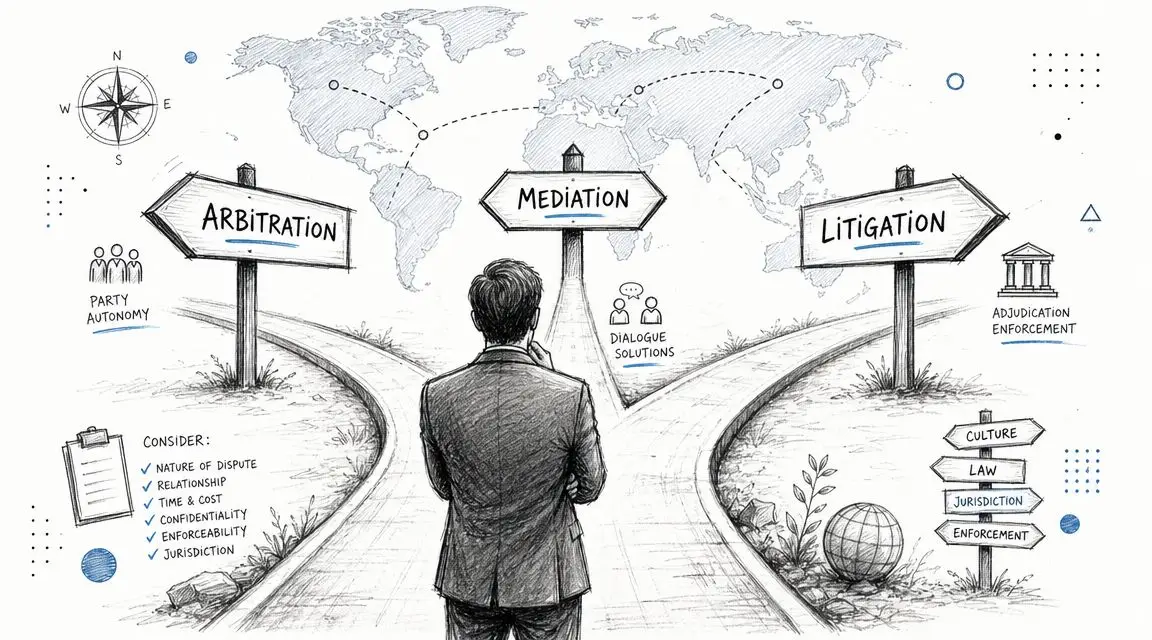
Forum selection is where legal drafting meets business reality. For a foreign company with an Israeli site, the dispute forum shapes the negotiating position before the first submission is filed. The right question isn’t “Which option is more legal?” The right question is “Which option preserves enforcement power and operational control?”
Start with the lease, not the dispute
The contract may already answer the most important questions. It may require notice periods, executive negotiation, mediation, arbitration, or exclusive court jurisdiction. If the clause is clear, strategy begins with compliance. If the clause is inconsistent, incomplete, or silent on escalation, the parties immediately start arguing about process instead of substance.
That early procedural fight weakens their position. It also invites tactical behavior, especially when one side wants delay and the other needs continuity. Cross-border businesses should read the dispute clause together with the default clause, cure language, service provisions, and governing law section. A strong clause acts as a roadmap. A weak clause creates two disputes instead of one.
Jurisdiction and enforcement shape the real answer
A local court may be practical if the evidence, premises, and witnesses sit in Israel. However, a neutral seat may be preferable where the parties come from different legal systems and need distance from home-court concerns. That calculation becomes more serious when the dispute may evolve into international commercial litigation, or when assets and enforcement targets sit outside Israel.
The enforcement question should come early, not after the award or judgment arrives. A result that cannot be executed efficiently is a weak result, even if the legal reasoning is strong.
A forum is only as good as its enforceability against the counterparty’s actual assets and decision-makers.
The practical criteria that matter
Executives usually focus on three factors.
- Operational urgency: Can the business wait for a full judicial track, or does it need a faster private process?
- Confidentiality needs: Will a public filing affect lenders, investors, partners, or brand positioning?
- Evidence burden: Is the dispute document-heavy, technical, and suitable for a specialist tribunal?
A strategic forum choice doesn’t chase elegance. It builds pressure where pressure will work.
Implementing a Phased Escalation Strategy
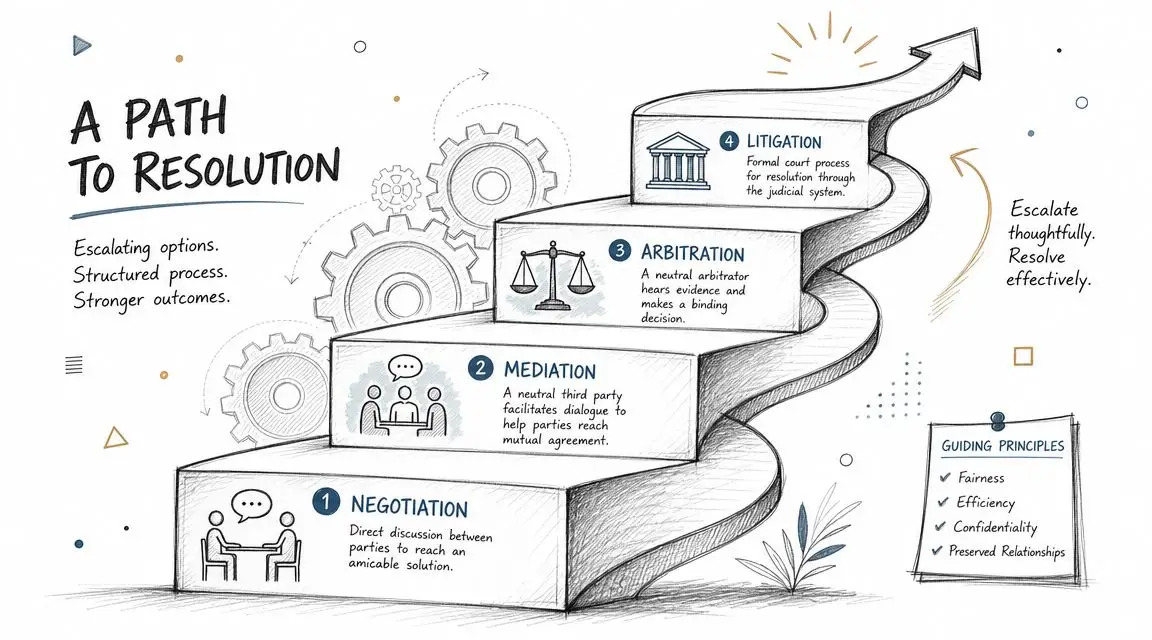
The strongest lease disputes rarely begin with the harshest weapon. They begin with structure. A phased escalation model treats negotiation, mediation, arbitration, and litigation as connected tools within a wider risk-control plan.
That approach matters because a lease conflict often unfolds under commercial stress. Payment pressure, occupancy decisions, vendor access, insurance questions, and public messaging can all move at once. A coherent path reduces noise and narrows the fight.
Stage one through stage three
The first stage is structured negotiation. It shouldn’t mean open-ended exchanges between junior personnel. It should mean a formal notice, a timetable for response, a document list, and a record of every position taken. If the parties can isolate the core issue early, they often avoid collateral claims.
The second stage is executive escalation. Business leaders can approve solutions that transactional teams and litigators cannot. They can trade timing, access, temporary pricing, or renewal concessions in a way that protects broader interests.
The third stage is time-bounded mediation. Mediation should not become a parking lot for indecision. It should occur after enough information has been exchanged to assess exposure, but before legal costs harden the parties’ positions.
Final stage and crisis alignment
If those stages fail, the matter moves to arbitration or litigation. At that point, the record is cleaner, the issues are narrower, and the company can proceed from an informed position rather than from anger. The legal process then supports a broader management response that may include board reporting, lender communication, and operational continuity planning.
This is why companies with a strategic outlook treat lease disputes as a form of commercial stress event, not a standalone legal file. The same disciplined thinking used in crisis management applies here. Decision chains must be clear. Messaging must stay consistent. Internal documents must be preserved before anyone improvises.
What works and what fails
What works in phased escalation:
- Short deadlines with real consequences: Open calendars invite delay.
- Named decision-makers: If authority is unclear, settlement stalls.
- One chronology: Facts, notices, invoices, and site events belong in a single timeline.
- Defined fallback: Everyone must know what happens when mediation ends without resolution.
What usually fails:
- Parallel informal channels: Side deals and unmanaged emails create contradictions.
- Aggressive threats too early: They trigger defensiveness before facts are stable.
- Mediation without preparation: A mediator cannot solve a file neither side has organized.
- Forum fights at the outset: They consume momentum that should target the merits.
A phased model doesn’t soften the dispute. It sharpens control.
Preserving Your Advantage Evidence Is Everything
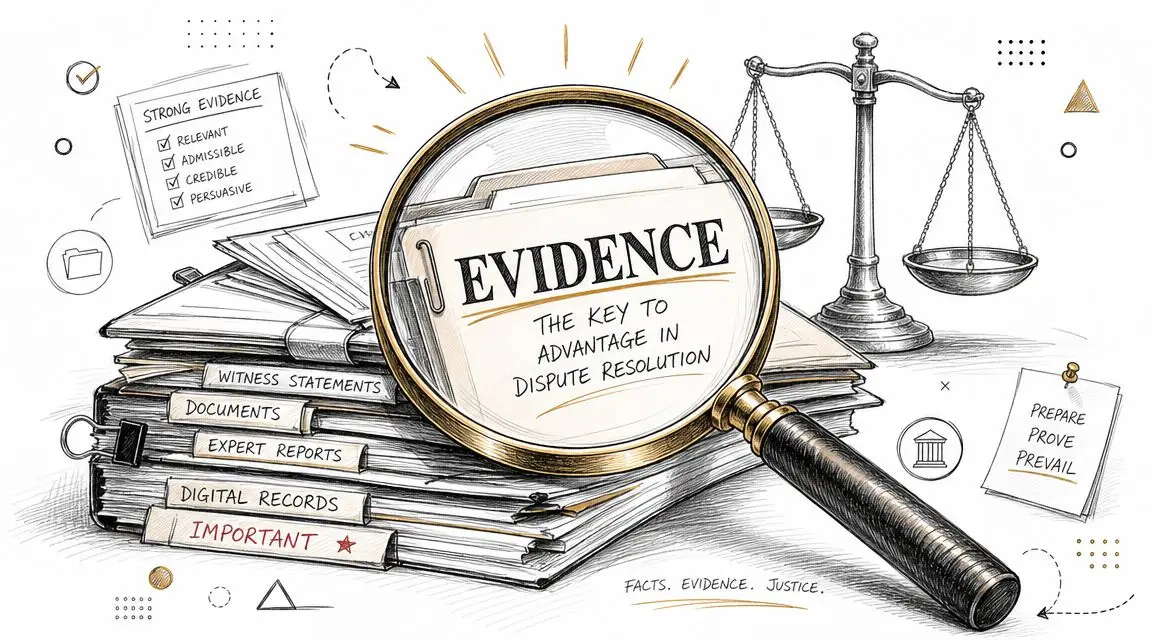
Most companies overestimate the power of argument and underestimate the power of records. In commercial lease disputes, the better file often wins before the formal case starts. The side that can prove dates, amounts, notice history, condition, and causation usually defines the settlement range.
Commercial lease disputes are won or lost on contemporaneous records, and the most critical evidence includes rent ledgers, maintenance logs, inspection reports, and written correspondence as detailed in BBG’s guidance on dispute resolution without court. That paper trail lets parties quantify exposure quickly and test realistic settlement positions without drifting into expensive damages battles.
The first 72 hours
The first response window matters most. Once a dispute surfaces, the company should freeze deletions, identify custodians, and gather the core record set. Teams that wait often lose chronology, context, and negotiating power.
A useful external primer on what qualifies as documentary proof appears in Documind’s evidence guide. In a lease conflict, that principle becomes highly practical.
- Lease pack: Signed lease, amendments, side letters, notices, guaranties, fit-out schedules.
- Payment record: Rent ledger, invoices, service-charge demands, reconciliation statements, proof of payment.
- Property condition file: Inspection reports, photographs, videos, maintenance tickets, repair logs.
- Communication set: Emails, letters, WhatsApp or other approved business messages, meeting notes, notice receipts.
- Operational impact material: Vendor delays, access restrictions, business interruption notes, internal approvals.
Why evidence beats posture
A party that produces a clean chronology looks credible. A party that relies on memory looks exposed. This is especially true in disputes over CAM charges, maintenance allocation, repair delays, and alleged defaults, where numbers alone don’t answer the question. The sequence of communications often decides whether a breach was material, waived, cured, or inflated.
Document discipline wins leverage before legal theory does.
Evidence also matters beyond the lease dispute itself. A company already dealing with financial pressure, lender review, or even bank account blockages cannot afford a fragmented record. In each of those settings, the side that organizes the file first usually controls the narrative.
Drafting Dispute-Proof Lease Clauses
The best dispute strategy starts before signature. A strong lease clause doesn’t merely choose a forum. It builds a process. That is the difference between a clause that manages friction and a clause that amplifies it.
Best-practice drafting uses a phased process architecture with a defined response window after notice, a duty to document communications, and a clear fallback if mediation fails according to Hopkins Centrich’s discussion of commercial lease disputes. Clear language reduces ambiguity, keeps more conflicts out of court, and protects business continuity.
What the clause should actually do
A useful dispute clause in an Israeli commercial lease should address process in sequence.
- Notice mechanics: State exactly how notice is served, when it is deemed received, and who must receive it.
- Initial negotiation window: Require a short period for business-side discussion before counsel-driven escalation.
- Document exchange duty: Obligate each side to produce the relevant lease and accounting records promptly.
- Mediation trigger: Set a specific point at which mediation becomes mandatory or optional.
- Fallback route: State whether unresolved disputes proceed to arbitration or court, and under which governing law.
That architecture belongs inside the broader lease package, especially where the parties are also negotiating commercial lease agreements with technical rent, repair, and service-charge provisions. A dispute clause cannot fix bad economics. It can, however, stop manageable disagreements from turning procedural.
Sample concepts that improve outcomes
Clause language should stay plain. It should also leave little room for gamesmanship.
If a dispute arises, each party must appoint a business representative with authority to settle within the stated response period.
That single concept solves many avoidable delays. Another strong concept requires a written chronology and supporting documents before mediation. A third identifies the final forum and confirms what happens if one side refuses to participate.
Weak drafting usually has the same flaws. It says disputes “may” be discussed. It names mediation but gives no timetable. It requires arbitration but omits the seat, rules, or appointment mechanism. Those gaps don’t create flexibility. They create avoidable cost.
Conclusion From Dispute to Decisive Advantage
A serious lease conflict in Israel is never only about square meters, rent, or repair obligations. It is about timing, bargaining power, evidence, and enforceability. Companies that treat commercial lease dispute resolution as a phased business process usually protect more value than those that react only after default notices arrive.
The sound strategic path is straightforward. Draft the clause as a process architecture. Choose the forum with enforcement in mind. Escalate in stages. Preserve evidence immediately. When those elements align, the dispute becomes manageable even in challenging circumstances.
Avoiding costly mistakes usually starts before the first notice is sent. Businesses facing cross-border lease exposure in Israel can contact RNC Group now to assess the contractual framework, evidence position, and escalation path before the dispute hardens into expensive litigation.
Disclaimer: The articles and information provided in this publication are for informational and educational purposes only and do not constitute legal advice. Reading this article does not create an attorney-client relationship. Readers should consult a qualified attorney for advice on any specific legal matter.