
A cross-border buyer often spends months on diligence, pricing, and financing, then loses control of the deal in the final stretch because one clause stayed vague. In Israeli transactions, that mistake becomes more dangerous when the target operates under local licenses, concentrated supplier relationships, founder-driven management, or regulatory friction that foreign buyers don’t fully map at signing.
The critical question for 2026 deals isn’t whether the sale and purchase agreement contains a material adverse change clause. It almost certainly does. The key question is whether that clause allocates Israeli operating risk with enough precision to survive a crisis, a closing dispute, and a judge’s scrutiny.
The Deal-Breaker Clause in Your 2026 M&A Agreement
Six weeks before closing, the target’s core supplier in Israel stops performing. Management says the disruption is temporary. The buyer’s credit committee says the business model may have changed. The seller insists the agreement still requires closing.
That conflict usually turns on a single provision: the material adverse change clause. Parties treat it like standard wording until the first serious shock hits. Then it becomes the clause that decides whether the buyer can refuse to close, whether the seller can force completion, and whether both sides must renegotiate under pressure.
For non-Israeli acquirers, the pressure multiplies quickly. Israeli targets often depend on key founders, concentrated customer bases, government interfaces, local permitting, and tightly linked banking relationships. A disruption that looks manageable in a board memo can become existential if it triggers financing concerns, labor departures, or regulatory attention before closing.
That is why experienced buyers don’t read the clause as a definition exercise. They read it as a live crisis protocol embedded in the contract. Sellers should do the same, because loose language invites opportunistic arguments and expensive litigation.
A disciplined exit strategy starts earlier than most deal teams assume. In that respect, the broader thinking behind Everglow’s business exit strategies is useful because it treats transaction planning as a controlled process rather than a last-minute event. The same discipline applies to MAC drafting. If the parties don’t decide in advance which shocks belong to the buyer and which remain with the seller, the dispute will be decided after value has already eroded.
Why vagueness survives negotiation
Vagueness isn’t accidental. Each side wants flexibility. The buyer wants room to invoke the clause if the target deteriorates sharply. The seller wants enough ambiguity to argue that no true deal-breaker occurred.
That tension explains why the provision often looks balanced on paper while hiding serious asymmetry in practice. The side that prepared a clearer factual record, narrower carve-outs, and better post-signing controls usually holds the stronger position when the dispute starts.
Practical rule: If the clause can’t be applied to a realistic Israeli operating crisis before signing, it won’t protect the parties after signing.
Understanding the MAC Clause as a Risk Allocation Tool
A material adverse change clause is a negotiated allocation of interim risk between signing and closing. In a cross-border acquisition of an Israeli target, that allocation can determine who carries the cost of a regulatory shock, an operational breakdown, or a sudden deterioration in management stability before funds move.
Serious buyers treat the clause as a pressure point, not as standard boilerplate. Serious sellers do the same. The central negotiation is about where the line sits between ordinary deal risk and target-specific deterioration that justifies a refusal to close, a price adjustment, or a renegotiation backed by litigation power.
That same logic appears in other contracting contexts. Analysis of professional employer organization risk reflects the same commercial exercise. The parties define categories of harm, decide who bears them, and tie those choices to specific remedies.
What the clause needs to accomplish
A usable MAC clause does three things.
- It defines the relevant type of harm. The clause should state whether the test applies to the target’s business, financial condition, operations, assets, regulatory standing, or a narrower set of identified value drivers.
- It sets a materiality threshold that can be applied under pressure. If the standard is too abstract, the dispute shifts from business impact to semantic argument.
- It allocates systemic versus company-specific risk. Buyers usually accept broad market events only if the target is not disproportionately affected. Sellers push hard to exclude macroeconomic shifts, changes in law, geopolitical events, and financing market disruption.
The drafting discipline matters because MAC disputes are rarely decided in calm conditions. They are raised when one side wants optionality and the other needs certainty. A clause that does not separate temporary volatility from sustained impairment gives both sides room to posture and neither side a clean answer.
In Israeli deals, that distinction needs special attention. Foreign acquirers often underestimate how quickly a local issue can become a closing crisis. A permit problem, a founder conflict, export control friction, reserve duty disruption affecting key technical personnel, or action by a bank or regulator may not fit neatly into generic U.S. or English precedent language. If the wording was imported from another market without adjustment, the clause may fail at the exact moment the buyer expects protection.
The better approach is to draft from the operational facts upward. Identify the assets, licenses, customer concentrations, management dependencies, and compliance exposures that drive value in the target. Then decide, expressly, which developments belong with the seller until closing and which pass to the buyer as part of the agreed deal risk.
That is how the MAC clause becomes useful in practice. It gives the parties a litigation position, a negotiation framework, and a crisis-management tool before the crisis arrives.
Common Triggers and Critical Exclusions
What will the buyer try to call a MAC the moment the deal comes under pressure, and what has the seller already carved out before that fight begins? That is the practical question. In a cross-border acquisition of an Israeli target, the answer often decides whether the buyer has real closing protection or only a negotiation talking point.
Trigger events that parties usually care about
The events that matter are usually specific, operational, and measurable. Buyers do not get far by pointing to general market anxiety. They get traction when the target loses a major customer, fails a regulatory inspection, suffers a serious product defect, loses a permit, faces litigation that threatens a revenue line, or sees the departure of management the business materially depends on.
In Israeli deals, one recurring trigger sits in plain sight. Site dependency. If the target needs one plant, one logistics hub, one laboratory, or one flagship retail location to generate most of its revenue, any dispute over possession, use rights, transferability, zoning, or operating restrictions can become a MAC argument within days. Foreign buyers often underprice that risk because the issue first appears in real estate diligence, not in the MAC schedule. A careful review of commercial lease agreements is often part of MAC risk analysis for exactly that reason.
Control and compliance issues also deserve special treatment. A bank covenant breach, an export control problem, a cyber incident affecting regulated data, or a founder dispute that freezes decision-making may not look dramatic at signing. At closing, each can undermine the buyer’s integration plan and financing assumptions.
The durational problem
Duration is usually the pressure point in any MAC dispute. A bad quarter may affect valuation. It does not necessarily justify walking away from the transaction. The clause should say, in substance, whether the parties are allocating the risk of a temporary earnings drop or a longer impairment of the business.
That is especially important for non-Israeli acquirers buying into sectors exposed to sudden local disruption. Reserve duty call-ups, permit suspensions, security restrictions, or abrupt regulatory intervention may hit performance hard but unevenly. If the clause says nothing about duration, the buyer argues structural damage and the seller argues temporary dislocation. Neither side has much contractual guidance.
A disciplined clause addresses both magnitude and persistence. It does not need a formula in every deal, but it should make clear that short-term volatility is treated differently from a sustained deterioration in earnings capacity, customer retention, regulatory standing, or business continuity.
Separate temporary disruption from lasting impairment.
Why exclusions often decide the case
Exclusions usually determine the outcome before any court does. Sellers want broad carve-outs for general economic decline, industry conditions, changes in law, security events, financing market disruption, and other external developments. Buyers can accept some of that allocation, but only if the clause brings the risk back when the target is hit materially harder than comparable businesses.
In Israeli transactions, that disproportionality concept needs careful drafting. A security event or regulatory change may affect the whole market formally, while in practice it shuts down one target’s facility, interrupts a specific supply route, or removes a license that only this business needs. Without a clear re-inclusion mechanism, the seller may argue that even severe target-level harm falls inside a broad market carve-out.
A useful negotiating framework appears below:
| Issue type | Seller position | Buyer response |
|---|---|---|
| General economic decline | Exclude from MAC | Re-include if the target is affected materially more than peers |
| Industry-wide downturn | Exclude from MAC | Measure against a defined peer group or objective benchmarks |
| Change in law or regulation | Exclude from MAC | Preserve MAC treatment for target-specific noncompliance or license failure |
| War or security event | Exclude from MAC | Re-include where the effect is concentrated on the target’s operations, workforce, or facilities |
| Customer or supplier loss | Usually included | Keep as a direct trigger, especially where concentration risk is known |
| Site or lease disruption | Fact-specific | Tie the analysis to operational dependency, substitute capacity, and time to cure |
What works and what doesn’t
Broad exclusions with no disproportionality qualifier usually leave the buyer with little real protection. Overwritten buyer language creates a different problem. If every carve-out contains multiple exceptions, re-exceptions, and inconsistent standards, the clause becomes harder to use in a live crisis and easier to attack in litigation.
The stronger approach is narrower and more commercial. Identify where the target can fail in a way that changes the bargain. Then draft triggers and exclusions around those facts. For an Israeli manufacturer, that may mean permits, utilities, site access, environmental compliance, labor availability, and security-related interruption. For a software business, the focus may shift to customer concentration, data rights, cybersecurity, export controls, and founder retention.
That is where experienced parties gain an advantage. They stop treating the MAC clause as generic boilerplate and start using it as a risk-allocation map for the specific deal they are signing.
Drafting Language Buyer vs Seller Perspectives
The economics of MAC drafting are often underestimated because the clause sits deep in the agreement. Yet negotiation over exclusions has measurable pricing impact. An empirical study of U.S. acquisition contracts found that each additional MAC exclusion was associated with a 1 percentage point reduction in the offer premium, and the coefficient on the number of exclusions was significant at the 0.005 level (Purdue working paper on MAC exclusions and acquisition dynamics).
That finding matters because it confirms what experienced deal lawyers already see in practice. Carve-outs are not decorative. They shift value.
Buyer-friendly and seller-friendly wording
The clearest way to evaluate the clause is to compare language by function rather than by style.
| Drafting issue | Buyer-friendly approach | Seller-friendly approach |
|---|---|---|
| Scope of harm | Covers business, operations, financial condition, assets, and prospects | Limits impact to narrowly defined current business condition |
| Forward-looking effects | Includes expected adverse consequences | Restricts analysis to present and proven effects |
| Carve-outs | Fewer, tighter exclusions | Broader exclusions for external and disclosed risks |
| Disproportionality | Broad re-inclusion right | Narrow or absent re-inclusion right |
| Knowledge and disclosure | Limits effect of seller disclosure | Expands exclusion for matters disclosed or known |
A buyer usually wants broad coverage, objective triggers, and a clear path to show that a post-signing event changed the company it agreed to purchase. A seller wants a tight definition, broad carve-outs, and language that prevents the buyer from weaponizing normal volatility.
Words that alter leverage
Certain drafting choices carry disproportionate effect.
- Prospects: Buyers like this term because it captures forward-looking damage. Sellers resist it because it widens uncertainty.
- Reasonably expected to: Buyers use it to address unfolding problems before full financial evidence arrives. Sellers often push for realized impact instead.
- Disproportionately affects: This phrase is essential when broad carve-outs exist. Without it, the buyer may carry sector-wide risk even if the target suffers much more severely than peers.
- Disclosed matters: Sellers want a wide disclosure shield. Buyers should define what counts as fair disclosure and avoid vague incorporation of the entire data room.
The Israeli drafting overlay
Cross-border deals involving Israel need one further adjustment. Drafting should reflect local operational dependencies rather than rely on generic Anglo-American wording. If the target depends on one regulator, one founder, one production site, one imported input, or one bank relationship, the clause should say how that risk is treated.
Negotiation insight: A MAC clause becomes dangerous when the definition looks broad, but the exclusions quietly remove the exact risks the buyer actually fears.
The strongest language isn’t the longest. It is the language that aligns the parties’ legal wording with the target’s real vulnerability map.
How Courts Interpret Material Adverse Change
A material adverse change clause is only as strong as the evidence behind it and the tribunal that reads it. Courts generally resist turning MAC provisions into easy termination rights. They look for serious deterioration, durable impact, and a tight link between the event and the contractual wording.

The importance of measurable benchmarks
One reason MAC disputes become expensive is that “material” often appears self-evident until a judge asks for proof. Recent English authority is therefore significant. In 2024, the English Commercial Court held that a 20% or more reduction in equity value would be material, while a drop of more than 15% might be material depending on the context (English Commercial Court guidance summarized by Kirkland & Ellis).
That decision matters because it gives market participants a concrete reference point. It doesn’t eliminate interpretation, and it doesn’t replace careful drafting. However, it does show that courts are increasingly willing to test MAC language against measurable benchmarks where the contract itself stays open-ended.
What that means for Israeli disputes
Israeli courts don’t operate as a copy of Delaware or the English courts. Still, in cross-border M&A disputes, Israeli judges and arbitrators will confront many of the same practical questions. Was the harm severe? Was it sustained? Did the event impair the target, or did it reveal a risk the buyer already assumed? Did the contract allocate that risk expressly elsewhere?
Those questions become sharper under Israeli law because local factual matrices can be dense. A court may need to assess regulatory interactions, financing conditions, founder behavior, disclosure quality, and post-signing conduct all at once. The result is that formal wording matters, but factual discipline matters more.
Why conduct after the event can decide the outcome
Many parties focus on proving materiality and forget the litigation damage caused by their own actions after the alleged event. A buyer that continues integration planning, approves amendments, delays reservation of rights, or speaks inconsistently across lenders, management, and the seller may weaken its case. A seller that minimizes the issue internally but describes it as temporary externally may create its own evidentiary problem.
The strongest MAC file usually contains three features:
- Contemporaneous documents that identify the event and its operational effect.
- A clear causation narrative showing why the deterioration resulted from the event rather than from ordinary market conditions.
- Consistent post-signing behavior aligned with the position later taken in court or arbitration.
Courts rarely reward a party that treated the event as manageable in real time and catastrophic only after the relationship soured.
For Israeli-facing transactions, this is the practical lesson. Drafting wins the argument only if the factual record supports it. Otherwise, the tribunal will read the clause narrowly and push toward deal certainty.
Strategic Actions for Negotiation and Crisis Management
What happens if the MAC issue appears on a Thursday night, your lenders call on Friday morning, and the Israeli regulator wants answers before the market opens? That is when the clause stops being boilerplate and starts operating as a pressure point in the deal.
What buyers should do before signing
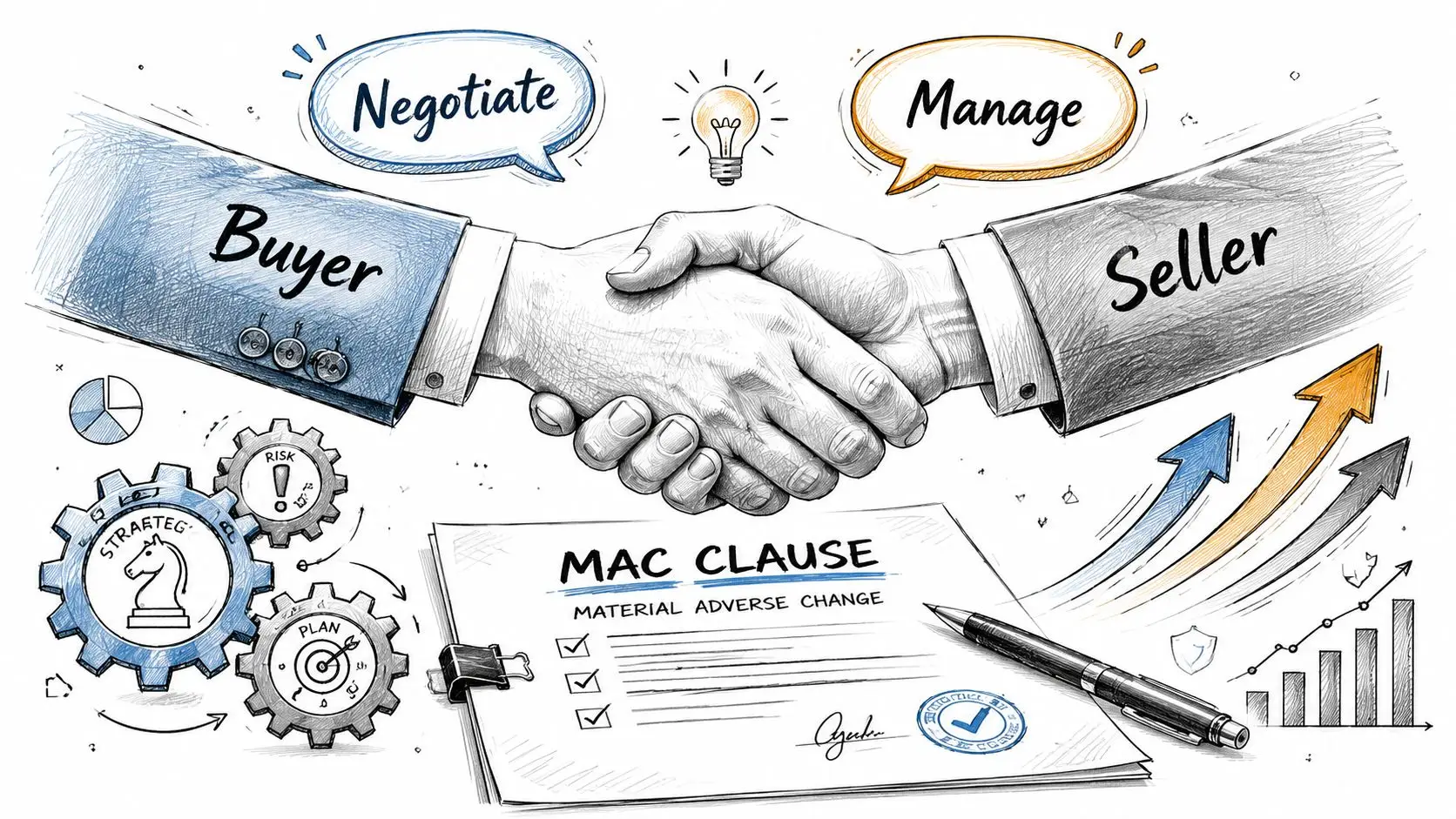
A buyer should draft the MAC clause around the target’s identified points of failure. Generic precedent language rarely protects a foreign acquirer buying into Israel where value may depend on a single license, a concentrated customer base, a key founder, one plant, or an imported input exposed to regulatory or security disruption. The clause should state which of those risks remain with the seller and which move to the buyer after signing.
The MAC definition also needs to work with the rest of the agreement. If disclosure is broad, scattered, or qualified by soft knowledge standards, a seller may argue that the very issue now cited as a MAC was already disclosed. If interim covenants permit wide operational changes, the buyer may lose the factual platform needed to say the business deteriorated in a deal-breaking way. Financing terms matter too. A MAC clause that is narrower than the debt commitment can leave the buyer trapped between a funder exit right and a purchase agreement that still requires closing.
For cross-border buyers, there is another layer. The clause should anticipate how an Israeli court or tribunal is likely to read ambiguity. Courts tend to focus on the agreed allocation of commercial risk and on whether the alleged event is company-specific, durable, and outside the ordinary volatility of the business. That makes precision more valuable than breadth.
What sellers should do before signing
A seller’s best defense is disciplined definition, followed by disciplined process. Carve-outs should be tied to risks the buyer is being paid to bear, such as general market deterioration, industry-wide disruption, changes in law, security events affecting the region, or macroeconomic shocks, while preserving a disproportionality qualifier where appropriate.
Disclosure should be organized in a way that can be proved later. In a dispute, the seller does not want to argue that the buyer was informed because the issue appeared in three data room folders, two management presentations, and one side email. The record should show where the point was disclosed, how it was described, and why that disclosure was sufficient under the contract.
Sellers should also test for inconsistency across representations, indemnities, earn-out mechanics, and closing conditions. I have seen sellers negotiate a favorable MAC carve-out, then give it away through a representation package or a covenant that creates a separate walk right. That is a drafting failure, not bad luck.
What both sides should do when the event occurs
Once a possible trigger appears, treat it as a live dispute and a business continuity event at the same time. Israeli-facing deals can deteriorate fast because the same development may affect banks, regulators, major customers, employees, and media coverage within days. Delay gives the other side room to frame the facts first.
The response should be centralized. Legal, finance, management, investor relations, and regulatory teams need one factual chronology, one internal assessment, and one approval path for outbound statements. A fragmented response is how parties create admissions they later spend months trying to explain.
A structured crisis management response often determines whether the matter ends in renegotiation, termination, or litigation. In some cases, the operational impact of the dispute can spill into banking relationships and trigger bank account blockages or other restrictions that make an already difficult closing harder to salvage.
A practical response sequence
- Create a command structure: Assign one decision group with authority over legal analysis, lender communication, regulator contact, and external messaging.
- Preserve the record from day one: Hold emails, board decks, management accounts, customer notices, compliance reports, and lender correspondence before narratives harden.
- Run a clause-by-clause test: Match the event against the trigger, each exclusion, each exception to the exclusion, and any knowledge or disclosure qualifier.
- Build an Israeli law strategy early: Assess forum, governing law, interim remedies, and how local evidence will be collected and presented if urgent relief becomes necessary.
- Control third-party communications: Statements to banks, auditors, major customers, and employees should support the contractual position and the commercial objective.
- Model the endgames: Prepare for cure, price adjustment, deferred closing, covenant tightening, or termination. The best outcome is often negotiated before either side files.
The strongest teams do more than argue about wording. They align contract interpretation, evidence, timing, and stakeholder management before the pressure reaches the closing table.
Checklist for Invoking or Resisting a MAC Claim
A MAC dispute shouldn’t begin with instinct. It should begin with a disciplined go or no-go assessment.
If the buyer wants to invoke the clause
- Identify the precise event: The buyer should isolate the actual post-signing event, not just point to weaker forecasts or general disappointment.
- Measure materiality against the contract: The claim must fit the agreed standard, whether quantitative, qualitative, or both.
- Test duration: If the problem looks temporary, the case weakens quickly.
- Check every carve-out: A strong factual event may still sit inside an exclusion.
- Build causation evidence: The buyer must show that the deterioration flowed from the event in question.
- Review conduct: Any post-event conduct that affirmed the deal may damage the claim.
If the seller wants to resist the clause
- Attack the trigger itself: The seller should ask whether the alleged event is real, target-specific, and contractually relevant.
- Use the carve-outs aggressively: If the issue falls within a systemic or disclosed-risk exclusion, that defense should lead.
- Challenge duration: Temporary turbulence shouldn’t be recast as lasting impairment.
- Challenge causation: The seller should separate company-specific issues from broader market conditions or pre-existing weakness.
- Audit the buyer’s behavior: Delay, mixed messaging, and continued deal performance may support waiver or affirmation arguments.
The go or no-go decision
Before either side escalates, decision-makers should ask three questions.
- Does the event fit the text?
- Can the evidence support sustained material harm?
- Has post-signing conduct preserved the legal position?
If any answer is weak, litigation strategy should shift toward gaining advantage, cure, repricing, or structured exit rather than a binary court fight.
Cross-border M&A disputes involving Israel rarely turn on one sentence alone. They turn on drafting quality, factual discipline, and crisis execution under pressure. To avoid costly mistakes and assess the right strategic path for a live transaction or dispute, contact RNC Group through its contact page.
This article provides general information only and does not constitute legal advice, a legal opinion, or a substitute for transaction-specific analysis under Israeli or any other applicable law. Reliance on this content without specific professional advice may expose readers to significant legal and commercial risk.